Last updated: November 21, 2026
Most “best helpdesk” lists are written for companies with a support department. This one is for stores where the same three people answer email, pack orders, and run Instagram.
That changes the answer. A tool built for 40 agents with a QA workflow is the wrong purchase at 300 tickets a month, no matter how good the reviews are.
How this list was built
No free trials were run for this page. Every price below was read from the vendor’s own pricing page between November 9 and 10, 2026, and every product claim comes from their public documentation.
What we did do is run the same store through each pricing model: three agents, 1,500 tickets a month, 40% automated. That comparison is where the real differences show up.
The list at a glance
| Tool | Charges by | Entry | Monthly cost at 3 agents, 1,500 tickets | Best for |
|---|---|---|---|---|
| Shopify Inbox | Free | $0 | $0 | Under 200 tickets a month |
| Richpanel | Order volume | $50 | $50 to $600 | Shopify stores with steady orders |
| Re:amaze | Agent | $29 | $147 | Small teams on a budget |
| Help Scout | User | $25 | $135 | Email-first support |
| Zendesk | Agent | $19 | $165 | Complex or regulated support |
| Gorgias | Ticket | $40 | $919 | Shopify brands that sell through support |
| eDesk | Agent plus outcome | $45 | $891 | Amazon and eBay sellers |
Prices move. These seven were checked this month; if you want the Gorgias numbers specifically, its pricing page is the source.
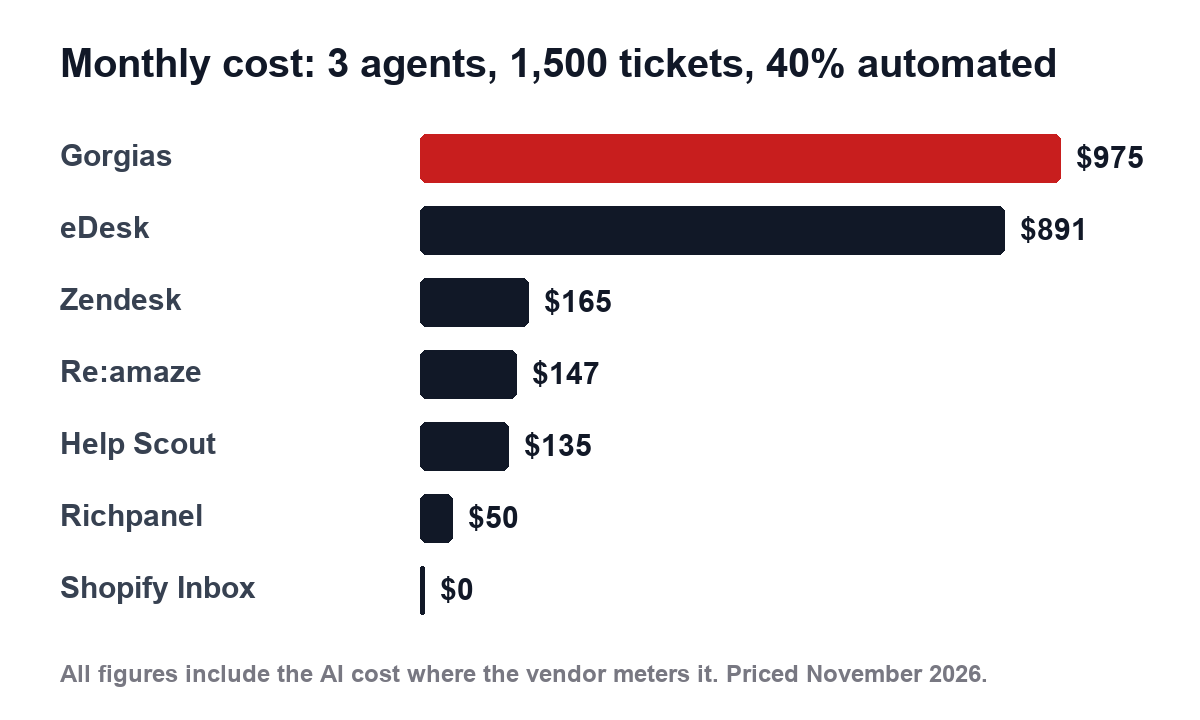
Read the fourth column before the third. Entry prices are marketing. The column next to it is what you actually pay.
1. Shopify Inbox, for the first six months
Free, built into Shopify, and better than most stores admit. It handles chat, collects email when nobody is online, and shows the order behind the conversation.
It falls apart at volume. No shared assignment, weak reporting, and no way to bring in Amazon messages. Below roughly 200 conversations a month, though, paying $550 for a helpdesk is a decision you can postpone.
2. Richpanel, for predictable volume
The only tool here that does not charge per person. Free up to 50 orders a month, $50 up to 500, $600 up to 10,000. Add five agents and the bill does not move.
For a store doing 1,500 orders a month with three or four people, nothing else comes close on price. The catch is the cliff between tiers, and the fact that $600 is a real jump for a store sitting at 10,001 orders.
One detail: their count is order volume, not ticket volume. A store with heavy pre-sale questions and few orders pays less than the ticket count would suggest.
3. Re:amaze, for the tightest budget
$29 per agent on Basic, $49 on Pro, roughly 10% off for annual. It covers email, chat, social, and Shopify order data, which is more than the price suggests.
It looks a decade old next to Gorgias, and the AI is not in the same league. If your team is three people and your questions are mostly “where is my order”, that trade is fine.
4. Help Scout, for email-heavy support
Free for up to five users, then $25, $45, or $75 per user a month on annual billing. The inbox is the most pleasant one here to work in, and the shared drafts feature alone saves hours a week on a small team.
Help Scout does not behave like an ecommerce tool. Order data arrives through an integration panel, not inside the ticket, and there is no marketplace support. If half your volume is Amazon, keep looking.
5. Zendesk, for complexity you actually have
$19 per agent for ticketing, $55 for the suite with messaging and voice, $115 for professional. Tickets are unlimited, which is the opposite of how Gorgias prices and better for high volume with few staff.
The cost is time. Zendesk is a toolkit, not a finished workflow. Most teams need two to four weeks of configuration, and the reporting everyone asks for in month two does not exist until someone builds it.
Buy it when you have compliance requirements, multiple business units, or a support organization that will outlive your current team. Otherwise the cheaper alternatives are worth a look.
6. Gorgias, for Shopify brands
$10 to $900 a month without the AI Agent, $40 to $1,430 with it, priced by ticket rather than agent. Pro at $550 with the AI Agent covers 2,000 tickets and 500 seats, which is why teams with ten agents pick it over per-seat tools.
The differentiator is order data inside the ticket. Agents refund, reship, and cancel without leaving the conversation. On most other tools that lives in a sidebar app, and the sidebar is only as good as the integration.
Watch the AI line. Pro includes 190 automated conversations inside its $550 and charges $0.90 past that. A store automating 40% of 2,000 tickets lands near $1,099 a month, not $550. We worked the full math in the Gorgias pricing breakdown.
7. eDesk, for marketplace sellers
$45 to $129 per agent plus $0.99 per AI outcome, with Amazon, eBay, Walmart, and Mirakl treated as native channels instead of add-ons. For a seller running three marketplaces, that is the whole reason to pick it.
Plan tiers are limited by store count, so a five-marketplace seller is on Growth at $99 per agent from day one. The eDesk pricing breakdown covers the tiers and the AI meter in detail.
What each billing model hides
Every tool in this list charges on one of three meters. Which one you are on decides what your bill does when the business changes, and none of the pricing pages explain that part.
Per agent. Zendesk, Help Scout, Re:amaze and eDesk all bill this way. The bill moves when you hire and stays flat when volume doubles. That is good news in a busy December with the same team, and bad news if you staff up for the season and then keep the seats.
Per ticket. Gorgias is the only one here. Seats are free, volume is not. A team of three and a team of ten pay the same, which is why agencies and bigger brands like it. The risk is the overage cliff: two thousand tickets costs $550, and four thousand costs $1,270 before AI.
Per order. Richpanel prices the store, not the people. A store doing 3,000 orders a month pays the same whether two people or eight are answering. For a founder-led team that hires before revenue catches up, this is the only model that does not punish the transition.
A store that grows 40% in a year
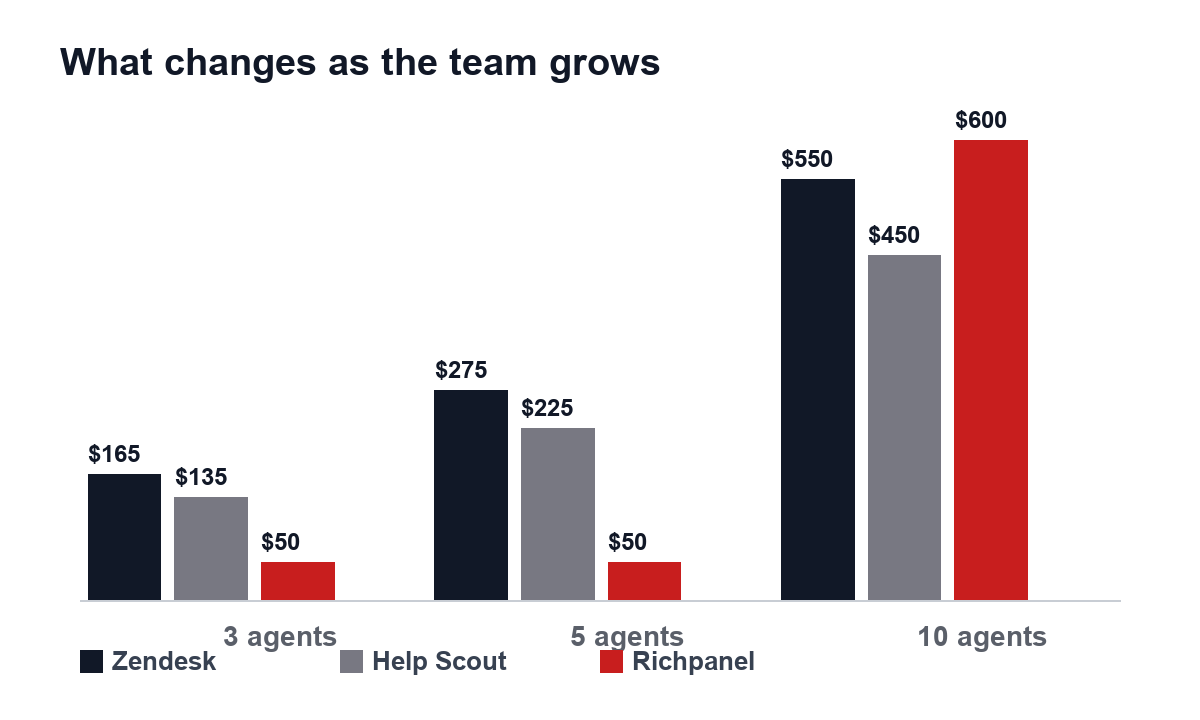
Start with three agents and 1,200 tickets. A year later it is five agents and 1,700 tickets. Run that through three tools at listed prices:
| Tool | Year one | Year two | Increase |
|---|---|---|---|
| Zendesk Suite Team | $165 | $275 | +$110 |
| Help Scout Plus | $135 | $225 | +$90 |
| Gorgias Pro | $919 | $919 | $0 |
| Richpanel | $50 | $50 | $0 |
The per order tool looks cheap in both years because the store stays under its order tier. The per ticket tool doubles its increase because both headcount and volume went up, and only one of those is priced.
What changed in 2026
Two years ago the plan was the whole bill. Today the AI line is often the largest single item, and it behaves differently at every vendor.
Zendesk bundles AI agents into Suite Team and above, so the cost is hidden inside the seat price. Gorgias now bundles an AI Agent fee into every plan and charges $0.90 per conversation past the allowance. eDesk includes nothing and charges $0.99 per resolved outcome from the first ticket. Freshdesk includes 500 AI agent sessions on every plan and sells Copilot separately at $29 per agent.
Same feature, four pricing philosophies, and the difference at 800 automated conversations is several hundred dollars a month. That is why every comparison on this site runs the same store through the same automation rate.
How to choose in ten minutes
Count your conversations last month, not your orders. Then add the channels you are not answering in a shared inbox yet, because migration usually doubles the number people expect.
If the count is under 200, stay on Shopify Inbox. Between 200 and 1,500 with a Shopify-only catalog, the shortlist is Richpanel and Gorgias. Above 1,500, run the AI math for both before deciding, because the overage line decides the bill at that size.
If Amazon is a real channel, eDesk wins by default. If your team is mostly answering email and the product is digital, Help Scout.
Three mistakes that cost money
Buying for seats you might hire. Every per-agent tool on this list charges for the team you have, not the team you plan to build. Start on the lower tier and upgrade when the invoice hurts less than the queue.
Ignoring the AI meter. It is the largest variable cost on every modern helpdesk and the one nobody models before signing. Multiply your automation rate by ticket volume by the per-outcome price, then look at the number.
Migrating twice. Moving from a free tool to a $50 tool and then to a $550 tool costs more in lost tickets and retraining than going straight to the right tier. If you expect to double in a year, buy for the year after this one.
Tools mentioned
Shopify Inbox (free), Richpanel ($50 to $600 by order volume), Re:amaze ($29 to $49 per agent), Help Scout ($25 to $75 per user), Zendesk ($19 to $115 per agent), Gorgias ($40 to $1,430 by ticket), eDesk ($45 to $129 per agent plus $0.99 per outcome).
When to keep the shared inbox
Helpdesk software solves coordination, not volume. If two people answer email and they sit next to each other, a shared inbox and a saved reply library does the same job for nothing.
The signal to move is when coordination starts costing sales. That usually shows up as a customer emailing twice because nobody claimed the thread, or a refund handled by two people at once. When that happens weekly rather than monthly, the subscription pays for itself.
There is a second signal: reporting. The moment someone asks how many conversations came from Instagram versus email, a free inbox stops being enough. Growth tier on most tools exists for exactly that question, and it costs $50 to $99 a month more than the entry tier.
Buying early is not fatal, it is just expensive. The tools take a day to set up and the plans can be changed monthly, so there is no locked-in penalty for starting late. Starting on the wrong meter, on the other hand, is harder to undo once the team has built habits around it.
FAQ
What is the best helpdesk for a small Shopify store?
Shopify Inbox while you are under 200 conversations a month, then Richpanel if order volume is predictable or Gorgias if support drives repeat purchases.
Which one is cheapest at 1,500 tickets a month?
Help Scout at $135 for three users, followed by Re:amaze at $147. Neither handles marketplace channels the way eDesk does.
Do I need a helpdesk at all?
Not under 200 conversations a month. A shared inbox and a saved reply library will carry you until the queue starts costing sales.
Is Zendesk worth the setup time?
Only if you have the complexity it is built for. For a Shopify store with three agents, the configuration time costs more than the subscription.
How much should I budget for AI in 2026?
Roughly $1 per resolved conversation across the market. At 40% automation on 1,500 tickets, budget $600 a month and treat anything lower as a bonus.
If Shopify is your main channel
The trial shows your real ticket count and your real automation rate. Those two numbers decide the plan, and neither appears on a comparison table.
Related comparisons: Gorgias vs Zendesk, seven Gorgias alternatives priced, and eDesk pricing, and seven Zendesk alternatives.
Disclosure: this page contains affiliate links. If you start a paid plan through one of them, we earn a commission at no extra cost to you. Prices checked November 2026.
Leave a Reply