Category: Helpdesk Software

  • Zendesk Alternatives 2026: Six Options Priced on One Store

    Zendesk Alternatives 2026: Six Options Priced on One Store

    Zendesk is the tool people buy when they expect to grow. Then the invoice arrives, the seat count goes up, and someone starts wondering what else is out there.

    The usual trigger is price per agent. Zendesk charges $55 per agent for the suite with messaging and AI, so ten agents is $550 before add-ons. The second trigger is setup time, which runs two to four weeks before the queue looks like your old one.

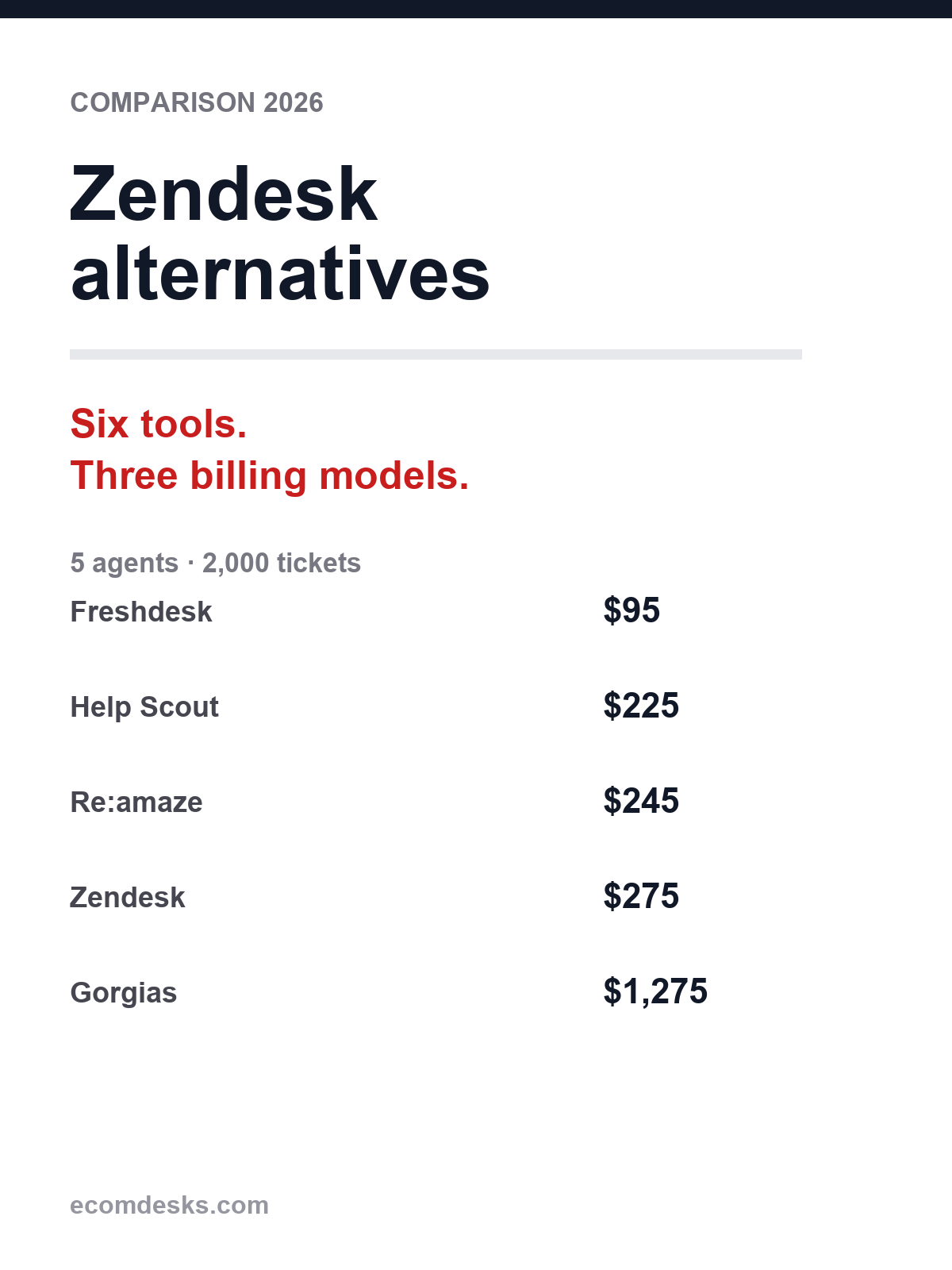
    Six alternatives below, priced on the same store: five agents, 2,000 tickets a month, 40% automated. That is 800 AI conversations.

    The comparison

    ToolCharges byPlan usedMonthly total
    Zendesk (for reference)AgentSuite Team$275
    Help ScoutUserPlus, annual$225
    Re:amazeAgentPro$245
    RichpanelOrder volumeStarter to Pro$50 to $600
    FreshdeskAgentGrowth, annual$95 plus AI add-on
    GorgiasTicketPro$1,099
    eDeskAgent plus outcomeGrowth, annual$1,287

    Zendesk is the anchor here, but most readers comparing it for Shopify work end up on Gorgias.

    Note the spread. At this team size the per-agent tools are the cheap end, and the ticket-priced tools are the expensive end. Flip to fifteen agents and the ranking flips with it.

    Freshdesk, the closest like for like

    $19 per agent on Growth billed annually, $55 on Pro, with 500 AI agent sessions included, Copilot at $29 per agent, and extra sessions at $49 per 100.

    Five agents lands at $95 a month, roughly a third of Zendesk Suite Team. The interface is plainer and the automation builder is less flexible, but for a store answering order questions it covers the job.

    Budget for the AI add-on. Without it you are comparing a 2026 tool against a 2026 tool with the automation switched off.

    Gorgias, for Shopify stores

    Priced by ticket instead of seat. Pro covers 2,000 tickets for $360 a month, or $550 with the AI Agent and allows 500 seats, so a ten person team pays the same as a three person team.

    At 800 automated conversations, 610 sit past the 190 included and bill at $0.90, which adds $549 and puts the total at $1,099. That number surprises people, and it is the single most important line to check before switching. The full pricing breakdown works through the tiers.

    What you get for it: order data inside the ticket, refunds and reships without leaving the conversation, and an AI agent that can recommend products rather than just answer questions.

    eDesk, for marketplace sellers

    $45 to $129 per agent plus $0.99 per AI outcome. Amazon, eBay, Walmart and Mirakl are native channels, which is the reason to consider it if Zendesk’s marketplace setup felt like a workaround.

    Five agents on Growth is $495, and 800 outcomes adds $792. Total $1,287. The eDesk pricing page covers which plan fits which store count.

    Help Scout, for email-heavy teams

    Free up to five users, then $25, $45 or $75 per user on annual billing. At five agents on Plus that is $225, the cheapest credible option in this table.

    The inbox is the best in class and the shared drafts save real hours. What you lose against Zendesk: routing complexity, voice, and any kind of marketplace support. Order data arrives in a sidebar, not in the ticket.

    Re:amaze, the budget pick with range

    $29 per agent on Basic, $49 on Pro, about 10% off annually. Five agents on Pro is $245, and it covers email, chat, social and Shopify order data without the Zendesk premium.

    It feels dated and the AI is thin. As a straight replacement for Zendesk’s ticketing at a fifth of the price, it works.

    Richpanel, if headcount is the problem

    The only option here that ignores seats entirely. Free up to 50 orders a month, $50 up to 500, $600 up to 10,000. Five agents or fifteen, the bill is the same.

    For a store doing 2,000 to 5,000 orders a month with a growing team, nothing in this list is cheaper. The catch is the cliffs between tiers, and the fact that pricing follows orders rather than conversations.
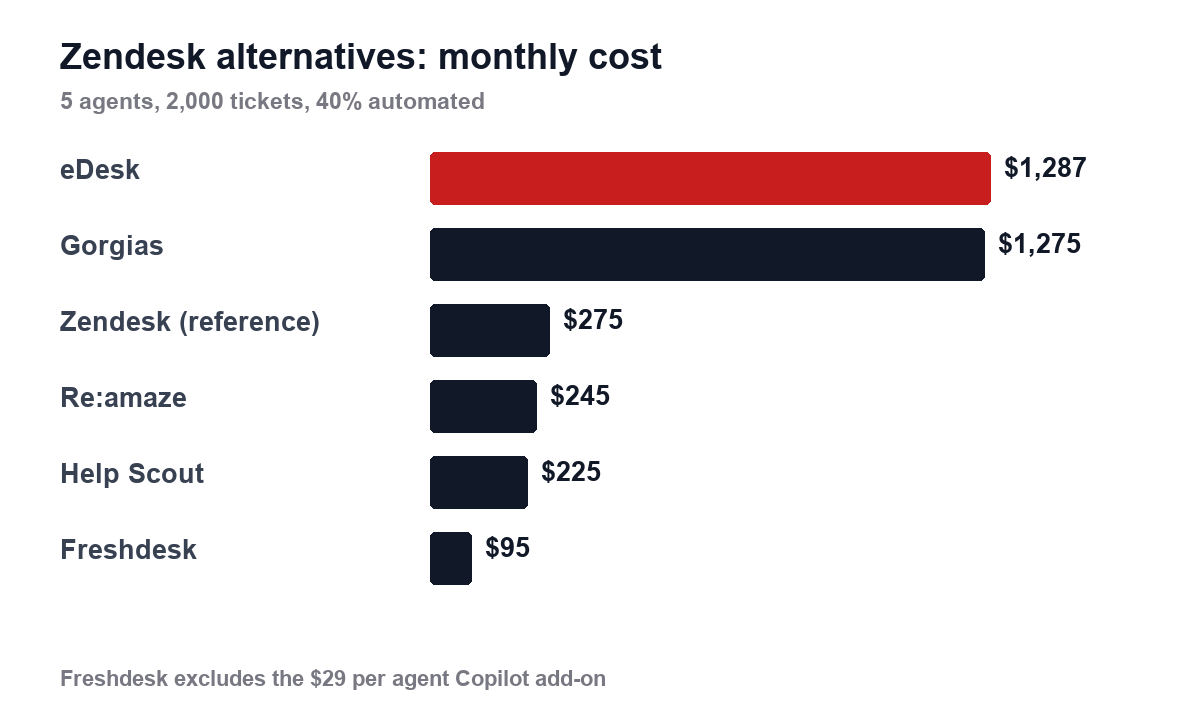
    Monthly cost of six Zendesk alternatives at five agents and 2,000 tickets
    The same five agents, priced across every option.

    When Zendesk is still the right answer

    If you run multiple business units, need SSO with SCIM, or answer to a compliance team, the alternatives here will cost you more in workarounds than you save on the invoice. Zendesk’s depth is real, it just is not free.

    The same applies to voice. Zendesk’s contact center is $83 per agent as an add-on, and none of the tools above replace it well.

    What migration actually costs

    Ticket history exports, but macros, triggers, views and reporting do not transfer cleanly. Plan on four to six weeks of parallel running, and keep the old account read-only for a quarter so nobody loses a thread.

    If you have years of Zendesk data and a team that knows the interface, that cost is the real barrier, not the subscription.

    The same tools at three team sizes

    Five agents is the middle of the range. Here is how the same stack looks when the team is smaller and when it doubles.

    Tool3 agents, 1,200 tickets5 agents, 2,000 tickets10 agents, 4,000 tickets
    Zendesk Suite Team$165$275$550
    Help Scout Plus$135$225$450
    Re:amaze Pro$147$245$490
    Freshdesk Growth$57$95$190
    Gorgias Pro$811$1,099$2,539
    eDesk Growth$772$1,287$2,574

    Gorgias and eDesk rise with volume, not headcount, which is why they look expensive here and cheap in a ten agent store handling the same ticket count. The per-agent tools do the opposite.

    How to test before you switch

    Run your last 200 tickets through the new tool’s import before you cancel anything. Look at two things: whether the customer history attaches correctly, and whether your most used macro can be rebuilt in under five minutes.

    Then check the AI on your own traffic for a week. The percentage it resolves is the number that decides plan size on every metered tool in this list. Vendor claims run from 40% to 65%, your store will land somewhere else.

    If the trial has no credit card requirement, take the full two weeks. Switching costs more in attention than in subscription, and the trial is the cheap part of the exercise.

    FAQ

    What is the cheapest Zendesk alternative?

    Freshdesk at $19 per agent on annual billing, or Help Scout at $25 per user. Both cost a fraction of Zendesk Suite Team at the same headcount.

    Which alternative is best for Shopify?

    Gorgias, because order data sits inside the ticket. Richpanel is the cheaper option if your order volume is predictable and your team is growing.

    Can I keep my Zendesk ticket history?

    The tickets export. The rules, macros and reports do not come with them, so most teams rebuild the workflow from scratch.

    Do any of these include AI in the base price?

    Zendesk bundles AI agents into Suite Team and above. Gorgias and eDesk meter it separately. Freshdesk includes 500 AI agent sessions on every plan, then charges $49 per 100.

    Is switching worth it for a five person team?

    At $275 a month against $95 to $245, the saving is $30 to $180 monthly. Worth it if the setup time is genuinely lower. Not worth it if you are trading away routing or reporting you rely on.

    If Shopify is the channel that matters

    Gorgias prices by ticket and gives away seats, which flips the math once your team grows. The trial shows your real volume in seven days.

    Start the Gorgias free trial

    Related: Gorgias vs Zendesk, Gorgias alternatives, and the full ecommerce helpdesk comparison.

    Disclosure: this page contains affiliate links. If you start a paid plan through one of them, we earn a commission at no extra cost to you. Prices checked November 12, 2026.
  • Best Helpdesk Software for Ecommerce 2026: Seven Tools, Seven Bills

    Best Helpdesk Software for Ecommerce 2026: Seven Tools, Seven Bills

    Most “best helpdesk” lists are written for companies with a support department. This one is for stores where the same three people answer email, pack orders, and run Instagram.

    That changes the answer. A tool built for 40 agents with a QA workflow is the wrong purchase at 300 tickets a month, no matter how good the reviews are.

    How this list was built

    No free trials were run for this page. Every price below was read from the vendor’s own pricing page between November 9 and 10, 2026, and every product claim comes from their public documentation.

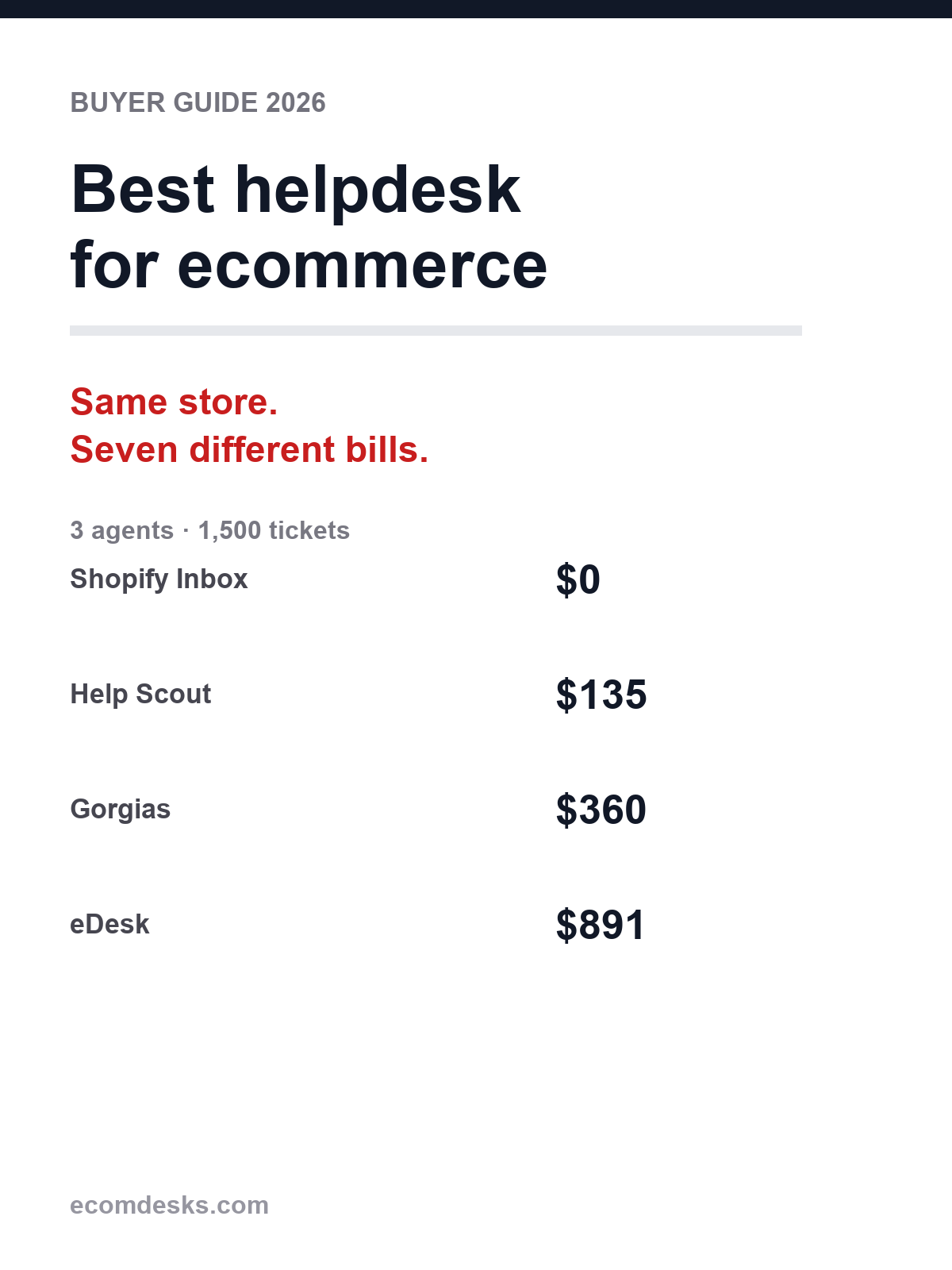
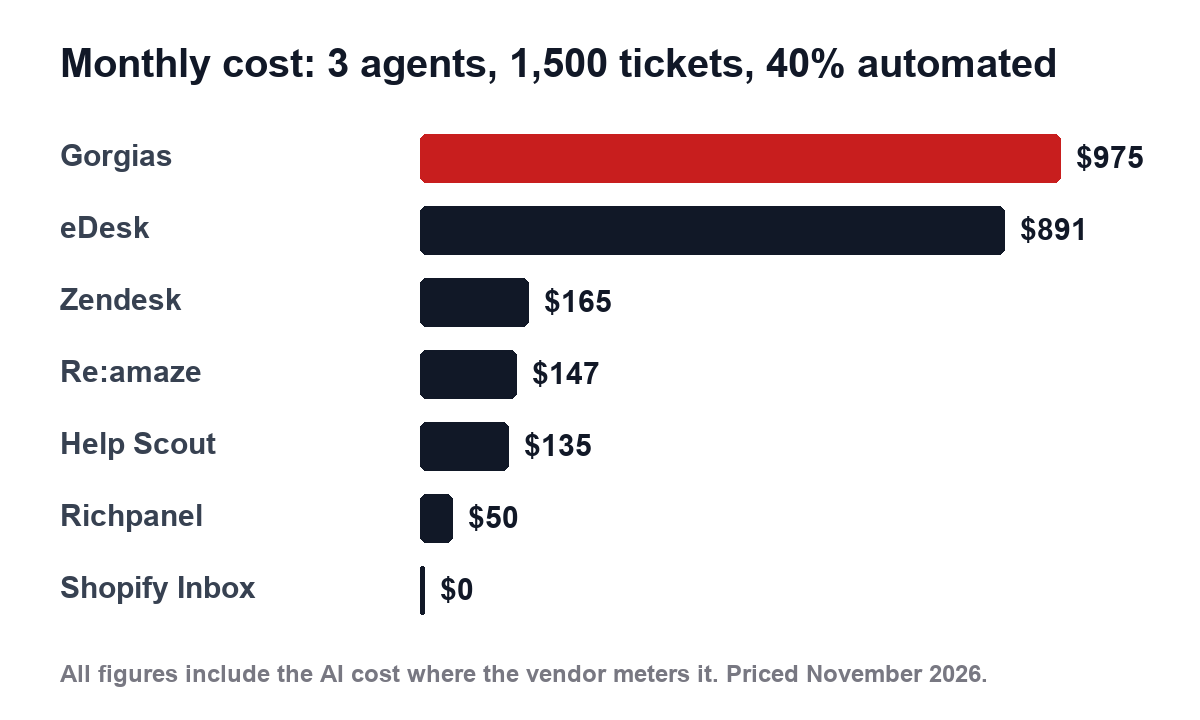
    What we did do is run the same store through each pricing model: three agents, 1,500 tickets a month, 40% automated. That comparison is where the real differences show up.

    The list at a glance

    ToolCharges byEntryMonthly cost at 3 agents, 1,500 ticketsBest for
    Shopify InboxFree$0$0Under 200 tickets a month
    RichpanelOrder volume$50$50 to $600Shopify stores with steady orders
    Re:amazeAgent$29$147Small teams on a budget
    Help ScoutUser$25$135Email-first support
    ZendeskAgent$19$165Complex or regulated support
    GorgiasTicket$40$919Shopify brands that sell through support
    eDeskAgent plus outcome$45$891Amazon and eBay sellers

    Prices move. These seven were checked this month; if you want the Gorgias numbers specifically, its pricing page is the source.

    Monthly cost of seven ecommerce helpdesks at three agents and 1,500 tickets
    Same store, same ticket volume, seven different bills.

    Read the fourth column before the third. Entry prices are marketing. The column next to it is what you actually pay.

    1. Shopify Inbox, for the first six months

    Free, built into Shopify, and better than most stores admit. It handles chat, collects email when nobody is online, and shows the order behind the conversation.

    It falls apart at volume. No shared assignment, weak reporting, and no way to bring in Amazon messages. Below roughly 200 conversations a month, though, paying $550 for a helpdesk is a decision you can postpone.

    2. Richpanel, for predictable volume

    The only tool here that does not charge per person. Free up to 50 orders a month, $50 up to 500, $600 up to 10,000. Add five agents and the bill does not move.

    For a store doing 1,500 orders a month with three or four people, nothing else comes close on price. The catch is the cliff between tiers, and the fact that $600 is a real jump for a store sitting at 10,001 orders.

    One detail: their count is order volume, not ticket volume. A store with heavy pre-sale questions and few orders pays less than the ticket count would suggest.

    3. Re:amaze, for the tightest budget

    $29 per agent on Basic, $49 on Pro, roughly 10% off for annual. It covers email, chat, social, and Shopify order data, which is more than the price suggests.

    It looks a decade old next to Gorgias, and the AI is not in the same league. If your team is three people and your questions are mostly “where is my order”, that trade is fine.

    4. Help Scout, for email-heavy support

    Free for up to five users, then $25, $45, or $75 per user a month on annual billing. The inbox is the most pleasant one here to work in, and the shared drafts feature alone saves hours a week on a small team.

    Help Scout does not behave like an ecommerce tool. Order data arrives through an integration panel, not inside the ticket, and there is no marketplace support. If half your volume is Amazon, keep looking.

    5. Zendesk, for complexity you actually have

    $19 per agent for ticketing, $55 for the suite with messaging and voice, $115 for professional. Tickets are unlimited, which is the opposite of how Gorgias prices and better for high volume with few staff.

    The cost is time. Zendesk is a toolkit, not a finished workflow. Most teams need two to four weeks of configuration, and the reporting everyone asks for in month two does not exist until someone builds it.

    Buy it when you have compliance requirements, multiple business units, or a support organization that will outlive your current team. Otherwise the cheaper alternatives are worth a look.

    6. Gorgias, for Shopify brands

    $10 to $900 a month without the AI Agent, $40 to $1,430 with it, priced by ticket rather than agent. Pro at $550 with the AI Agent covers 2,000 tickets and 500 seats, which is why teams with ten agents pick it over per-seat tools.

    The differentiator is order data inside the ticket. Agents refund, reship, and cancel without leaving the conversation. On most other tools that lives in a sidebar app, and the sidebar is only as good as the integration.

    Watch the AI line. Pro includes 190 automated conversations inside its $550 and charges $0.90 past that. A store automating 40% of 2,000 tickets lands near $1,099 a month, not $550. We worked the full math in the Gorgias pricing breakdown.

    7. eDesk, for marketplace sellers

    $45 to $129 per agent plus $0.99 per AI outcome, with Amazon, eBay, Walmart, and Mirakl treated as native channels instead of add-ons. For a seller running three marketplaces, that is the whole reason to pick it.

    Plan tiers are limited by store count, so a five-marketplace seller is on Growth at $99 per agent from day one. The eDesk pricing breakdown covers the tiers and the AI meter in detail.

    What each billing model hides

    Every tool in this list charges on one of three meters. Which one you are on decides what your bill does when the business changes, and none of the pricing pages explain that part.

    Per agent. Zendesk, Help Scout, Re:amaze and eDesk all bill this way. The bill moves when you hire and stays flat when volume doubles. That is good news in a busy December with the same team, and bad news if you staff up for the season and then keep the seats.

    Per ticket. Gorgias is the only one here. Seats are free, volume is not. A team of three and a team of ten pay the same, which is why agencies and bigger brands like it. The risk is the overage cliff: two thousand tickets costs $550, and four thousand costs $1,270 before AI.

    Per order. Richpanel prices the store, not the people. A store doing 3,000 orders a month pays the same whether two people or eight are answering. For a founder-led team that hires before revenue catches up, this is the only model that does not punish the transition.

    A store that grows 40% in a year

    Start with three agents and 1,200 tickets. A year later it is five agents and 1,700 tickets. Run that through three tools at listed prices:

    ToolYear oneYear twoIncrease
    Zendesk Suite Team$165$275+$110
    Help Scout Plus$135$225+$90
    Gorgias Pro$919$919$0
    Richpanel$50$50$0

    The per order tool looks cheap in both years because the store stays under its order tier. The per ticket tool doubles its increase because both headcount and volume went up, and only one of those is priced.

    What changed in 2026

    Two years ago the plan was the whole bill. Today the AI line is often the largest single item, and it behaves differently at every vendor.

    Zendesk bundles AI agents into Suite Team and above, so the cost is hidden inside the seat price. Gorgias now bundles an AI Agent fee into every plan and charges $0.90 per conversation past the allowance. eDesk includes nothing and charges $0.99 per resolved outcome from the first ticket. Freshdesk includes 500 AI agent sessions on every plan and sells Copilot separately at $29 per agent.

    Same feature, four pricing philosophies, and the difference at 800 automated conversations is several hundred dollars a month. That is why every comparison on this site runs the same store through the same automation rate.

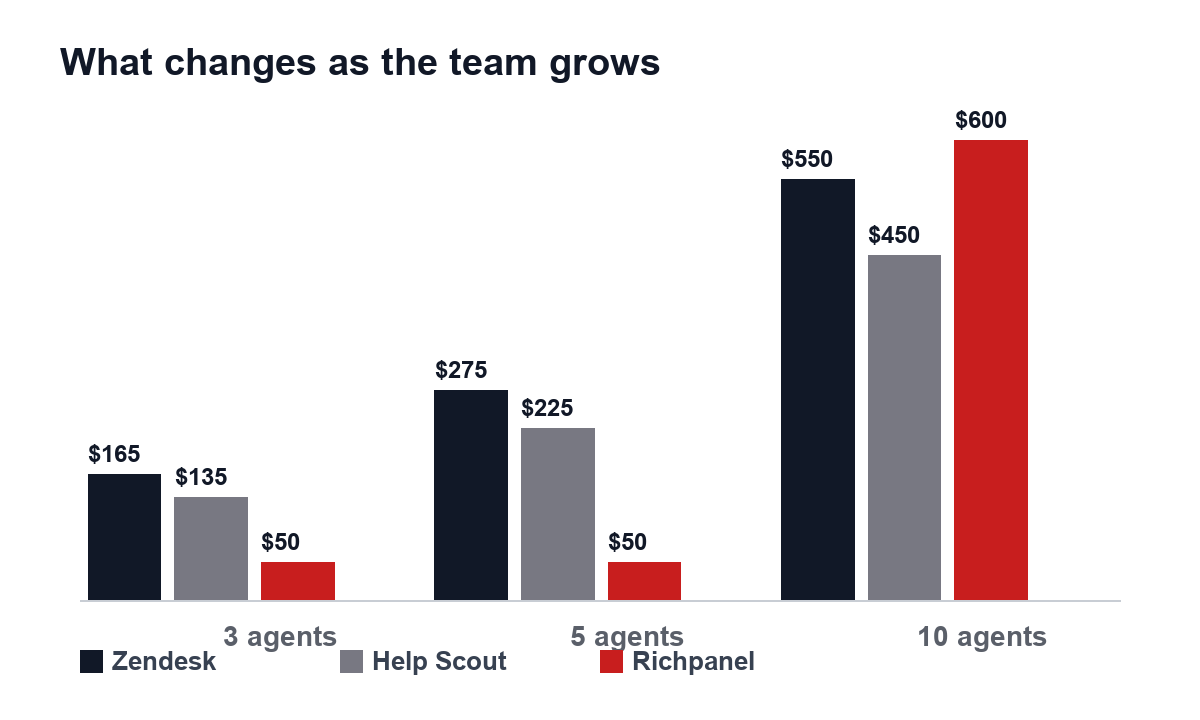
    Helpdesk cost per month as the support team grows from three to ten agents
    Per agent pricing rises with headcount. Per order pricing does not.

    How to choose in ten minutes

    Count your conversations last month, not your orders. Then add the channels you are not answering in a shared inbox yet, because migration usually doubles the number people expect.

    If the count is under 200, stay on Shopify Inbox. Between 200 and 1,500 with a Shopify-only catalog, the shortlist is Richpanel and Gorgias. Above 1,500, run the AI math for both before deciding, because the overage line decides the bill at that size.

    If Amazon is a real channel, eDesk wins by default. If your team is mostly answering email and the product is digital, Help Scout.

    Three mistakes that cost money

    Buying for seats you might hire. Every per-agent tool on this list charges for the team you have, not the team you plan to build. Start on the lower tier and upgrade when the invoice hurts less than the queue.

    Ignoring the AI meter. It is the largest variable cost on every modern helpdesk and the one nobody models before signing. Multiply your automation rate by ticket volume by the per-outcome price, then look at the number.

    Migrating twice. Moving from a free tool to a $50 tool and then to a $550 tool costs more in lost tickets and retraining than going straight to the right tier. If you expect to double in a year, buy for the year after this one.

    Tools mentioned

    Shopify Inbox (free), Richpanel ($50 to $600 by order volume), Re:amaze ($29 to $49 per agent), Help Scout ($25 to $75 per user), Zendesk ($19 to $115 per agent), Gorgias ($40 to $1,430 by ticket), eDesk ($45 to $129 per agent plus $0.99 per outcome).

    When to keep the shared inbox

    Helpdesk software solves coordination, not volume. If two people answer email and they sit next to each other, a shared inbox and a saved reply library does the same job for nothing.

    The signal to move is when coordination starts costing sales. That usually shows up as a customer emailing twice because nobody claimed the thread, or a refund handled by two people at once. When that happens weekly rather than monthly, the subscription pays for itself.

    There is a second signal: reporting. The moment someone asks how many conversations came from Instagram versus email, a free inbox stops being enough. Growth tier on most tools exists for exactly that question, and it costs $50 to $99 a month more than the entry tier.

    Buying early is not fatal, it is just expensive. The tools take a day to set up and the plans can be changed monthly, so there is no locked-in penalty for starting late. Starting on the wrong meter, on the other hand, is harder to undo once the team has built habits around it.

    FAQ

    What is the best helpdesk for a small Shopify store?

    Shopify Inbox while you are under 200 conversations a month, then Richpanel if order volume is predictable or Gorgias if support drives repeat purchases.

    Which one is cheapest at 1,500 tickets a month?

    Help Scout at $135 for three users, followed by Re:amaze at $147. Neither handles marketplace channels the way eDesk does.

    Do I need a helpdesk at all?

    Not under 200 conversations a month. A shared inbox and a saved reply library will carry you until the queue starts costing sales.

    Is Zendesk worth the setup time?

    Only if you have the complexity it is built for. For a Shopify store with three agents, the configuration time costs more than the subscription.

    How much should I budget for AI in 2026?

    Roughly $1 per resolved conversation across the market. At 40% automation on 1,500 tickets, budget $600 a month and treat anything lower as a bonus.

    If Shopify is your main channel

    The trial shows your real ticket count and your real automation rate. Those two numbers decide the plan, and neither appears on a comparison table.

    Start the Gorgias free trial

    Related comparisons: Gorgias vs Zendesk, seven Gorgias alternatives priced, and eDesk pricing, and seven Zendesk alternatives.

    Disclosure: this page contains affiliate links. If you start a paid plan through one of them, we earn a commission at no extra cost to you. Prices checked November 2026.

  • Gorgias Alternatives 2026: Seven Options and What Each Charges

    Gorgias Alternatives 2026: Seven Options and What Each Charges

    Price update: Gorgias changed its plan structure in November 2026 and now sells an AI Agent add-on on every tier. The Gorgias review carries the current numbers and the recalculated bills.

    Gorgias is the default pick for Shopify brands, and its four plans are the baseline every option here gets measured against. That is also why people go looking for something else, usually right after the first invoice that includes AI.

    One detail explains most of it. Gorgias sells the AI Agent as an add-on, $30 on Starter and Basic up to $530 on Advanced, and charges $0.90 per conversation past the allowance. The plan price on the page is the floor, not the bill, and the difference shows up before you send a single ticket.

    Seven realistic alternatives, with what each one actually charges in November 2026. Prices pulled from each vendor’s own pricing page.

    The short list

    ToolPricing modelEntry priceBest for
    eDeskPer agent + $0.99 per AI outcome$45 per agentAmazon and eBay sellers
    RichpanelPer order volume$50 per monthShopify stores with steady volume
    Re:amazePer agent$29 per agentSmall teams that want depth cheap
    Help ScoutPer user$25 per userEmail-first support, no ecommerce
    ZendeskPer agent$19 per agentEnterprise and compliance
    IntercomPer seat + $0.99 per Fin outcome$29 per seatSales-led chat
    KustomerPer agent, 8 seat minimum$89 per agentLarge contact centers

    Every figure in this table came from the vendor’s own page. Gorgias is the one most readers end up measuring the rest against.

    Entry prices hide the real bill, which is why the next section runs the same store through each one.

    One store, seven bills

    Take a store with three agents, 1,500 tickets a month, and a 40% AI resolution rate. That is 600 automated conversations.

    ToolPlan usedSubscriptionAITotal per month
    Help ScoutPlus, annual$135Included at this volume$135
    Re:amazePro$147Included$147
    ZendeskSuite Team, annual$165Bundled$165
    RichpanelStarter$50Included$50 to $600
    IntercomEssential$87$594$681
    KustomerEnterprise, 8 seat floor$712Extra$712 and up
    eDeskGrowth, annual$297$594$891

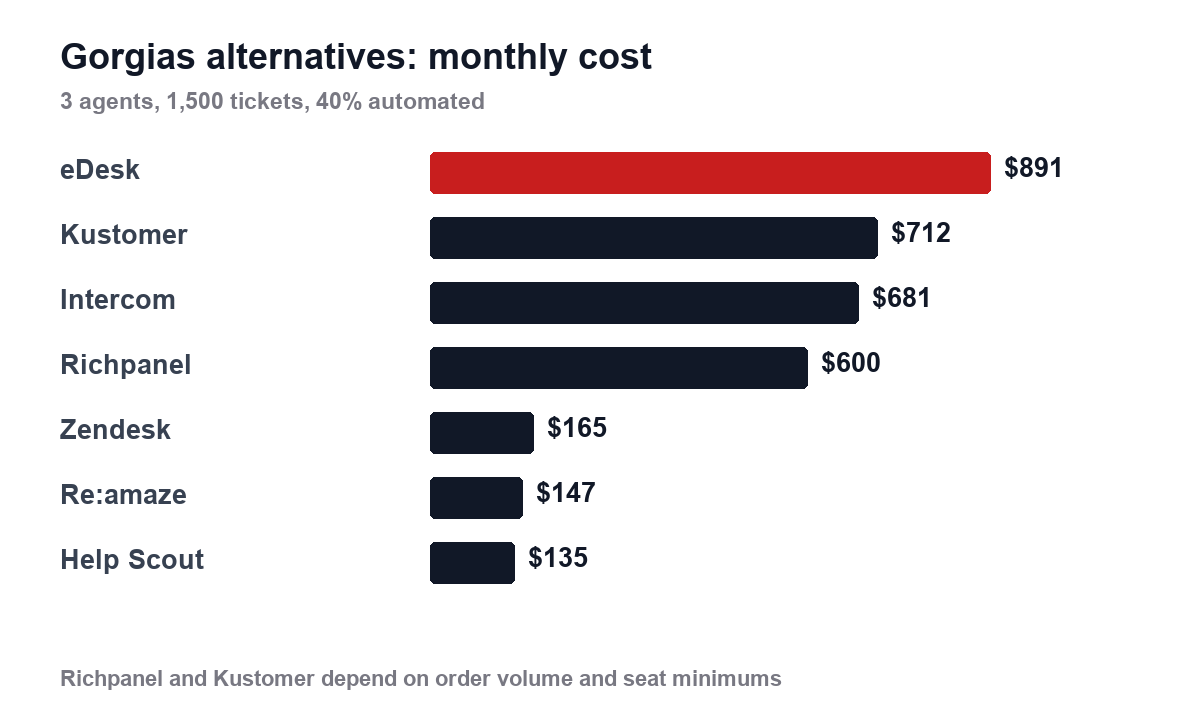
    Two things jump out. The AI line is bigger than the subscription for every tool that meters it. And Richpanel’s price depends on order volume rather than headcount, so the same store can pay $50 or $600 without changing its team.

    eDesk

    The marketplace specialist, and the eDesk pricing page breaks down the AI meter. Amazon, eBay, Walmart, and Mirakl are native channels rather than integrations, which matters if half your volume arrives through them. Shopify and TikTok Shop work too, just as secondary channels.

    $45 to $129 per agent on annual billing, plus $0.99 per AI outcome. The AI only charges when it actually answers or acts, and a thread counts once no matter how many messages it takes. That is a fairer meter than most.

    Downside: per agent pricing punishes seasonal hiring, and the AI line is unbounded. At 600 outcomes a month the fee is $594, twice the subscription.

    Richpanel

    The only one on this list that does not charge per person. Plans are tied to order volume: free up to 50 orders a month, $50 for 500, $600 for 10,000. Add ten agents and the price does not move.

    For a Shopify store doing 2,000 to 5,000 orders a month with a growing team, that is the cheapest structure here by a wide margin. The catch is the cliffs. Cross 500 orders and you jump from $50 to the next tier, not a smooth increase.

    Re:amaze

    The value pick. $29 per agent on Basic, $49 on Pro, with annual billing shaving about 10%. It covers email, chat, social, and Shopify order data without the Gorgias premium.

    It looks dated next to Gorgias, and the AI is not close. But at $147 a month for three agents with AI included, it is a third of what the same team pays on eDesk with automation running.

    Help Scout

    Free for up to five users, then $25, $45, or $75 per user per month on annual billing. Built for email-first support teams, and it shows. The inbox is the best in this list to actually work in.

    What it does not do well: ecommerce. Order data lives in an integration, not in the ticket, and there is no marketplace support at all. If your questions are about shipping a physical product, this is the wrong shape.

    Zendesk

    $19 per agent for basic ticketing, $55 for the suite with messaging and voice, $115 for professional. Tickets are unlimited, which flips the math for high volume teams with few agents.

    The trade is setup time. Zendesk arrives as a toolkit, and the head-to-head comparison covers the cost at four team sizes. Expect weeks of configuration before it matches how your team already works, and budget for a consultant if nobody internal owns it.

    Intercom

    $29 per seat on Essential, $85 on Advanced, plus $0.99 per Fin outcome. The AI is the strongest in this group, and the price reflects it. A three agent team with 600 automated conversations pays $681 a month before add-ons.

    Worth it if support is a sales channel and chat drives revenue. Wasteful if you are answering where-is-my-order emails.

    Kustomer

    $89 per seat, annual contracts only, eight seat minimum. That is $712 a month before you answer a single ticket. Built for contact centers with thousands of conversations a day and a compliance team.

    If you are reading this list, you are probably not the buyer. Mentioned for completeness, because it shows up in every comparison and the price is usually buried.

    Monthly cost of seven Gorgias alternatives at three agents and 1,500 tickets
    Seven tools, seven bills, one store.

    What I would pick

    Shopify only, three to eight agents, mostly order questions: Richpanel if your order volume is predictable, Gorgias if you want the AI to sell as well as answer. Richpanel is cheaper, Gorgias is better at revenue.

    Amazon or eBay is a real channel: eDesk, without much debate. Nothing else on this list treats marketplace messaging as a first class citizen.

    Email-heavy, no product to ship: Help Scout. Small budget and you can live without polish: Re:amaze. Enterprise with auditors in the room: Zendesk.

    FAQ

    What is the cheapest Gorgias alternative?

    Help Scout at $25 per user on annual billing, or Re:amaze at $29 per agent. Neither handles ecommerce order data as well as Gorgias does.

    Which alternative has the best AI?

    Intercom’s Fin, then Gorgias. Both charge about $1 per resolved conversation, and both are more expensive than the tools that bundle a smaller allowance.

    Do any of these charge per ticket instead of per agent?

    Gorgias charges per ticket. Richpanel charges per order volume, which is a different meter again. The rest charge per agent or per seat.

    Can I switch from Gorgias without losing ticket history?

    History exports, but routing rules, macros, and reporting do not transfer cleanly. Plan on four to six weeks of parallel running, and keep the old account read-only for a quarter.

    Still the best fit for Shopify

    If the alternative you are considering is a cheaper way to handle order questions, the trial is still the fastest way to compare. Seven days, no card, real ticket volume.

    Start the Gorgias free trial

    Still deciding: seven ecommerce helpdesks priced on one store.

    Disclosure: this page contains affiliate links. Prices checked November 9 and 10, 2026 and can change. Some tools on this list do not have an affiliate program and are linked plainly.

  • eDesk Pricing 2026: Four Plans, the $0.99 AI Fee, and the Real Bill

    eDesk Pricing 2026: Four Plans, the $0.99 AI Fee, and the Real Bill

    eDesk publishes four plans and one number that does most of the damage: $0.99 per AI outcome. The plans look cheap next to Gorgias. The AI line can double or triple the bill, and it sits below the fold on the pricing page.

    Everything below was read off eDesk’s pricing page on November 10, 2026, and run through three store sizes.

    The four plans

    PlanAnnual, per agentMonthly, per agentStoresWhat it adds
    Essential$45$551Shared inbox, live chat, social messaging, rule-based automations
    Growth$99$1255Performance reporting, CSAT surveys
    Professional$129$15910Assisted onboarding, two free read-only users
    EnterpriseCustomCustomUnlimitedDedicated account manager, multi-brand workflows

    eDesk publishes its own rates, and so does Gorgias. If the $0.99 per outcome is the deciding line, check Gorgias’s current plans before you commit.

    Annual billing saves about 18%. Most helpdesks discount 15 to 20%, so that part is normal.

    The plan boundaries are stores, not features. One store on Essential, five on Growth, ten on Professional. If you run Amazon US, Amazon UK, eBay, and a Shopify store, you need Growth on day one. That is $99 per agent instead of $45.

    The AI meter, in detail

    $0.99 per outcome, on every plan, with no included allowance. The definition of an outcome is narrow and it works in your favour.

    The customer got an answer, or the AI took an action like approving a return. If the customer writes back four more times in the same thread, it is still one charge. If the AI fails and hands the ticket to a human, there is no charge at all.

    Compare that to Gorgias, which includes 30 to 530 AI conversations depending on plan and charges $0.90 for each one past the allowance, whether or not it worked. At 600 automated conversations a month, eDesk costs $594. Gorgias on Pro costs $550 with the AI Agent plus $369 in overage, so $919.

    On AI alone, eDesk is roughly 40% cheaper at that volume. The gap narrows as you add agents, because eDesk charges for people and Gorgias does not.

    Three add-ons that are not in the plans

    AI Assist runs $39 per agent per month. It drafts replies for human agents rather than answering customers, which is a different job from the AI Agent and a separate charge.

    Translation is $21 per agent per month. Worth it if you sell across languages, useless otherwise.

    Feedback is $109 per account per month. CSAT surveys are included from Growth, so this is the deeper feedback product, not the basic surveys.

    Add AI Assist to five agents and you have added $195 a month to a $495 subscription. That is the pattern to watch: the plan is the floor, not the price.

    eDesk monthly bill split between subscription and AI outcomes
    The AI meter is the bigger line at every size.

    Three bills, worked through

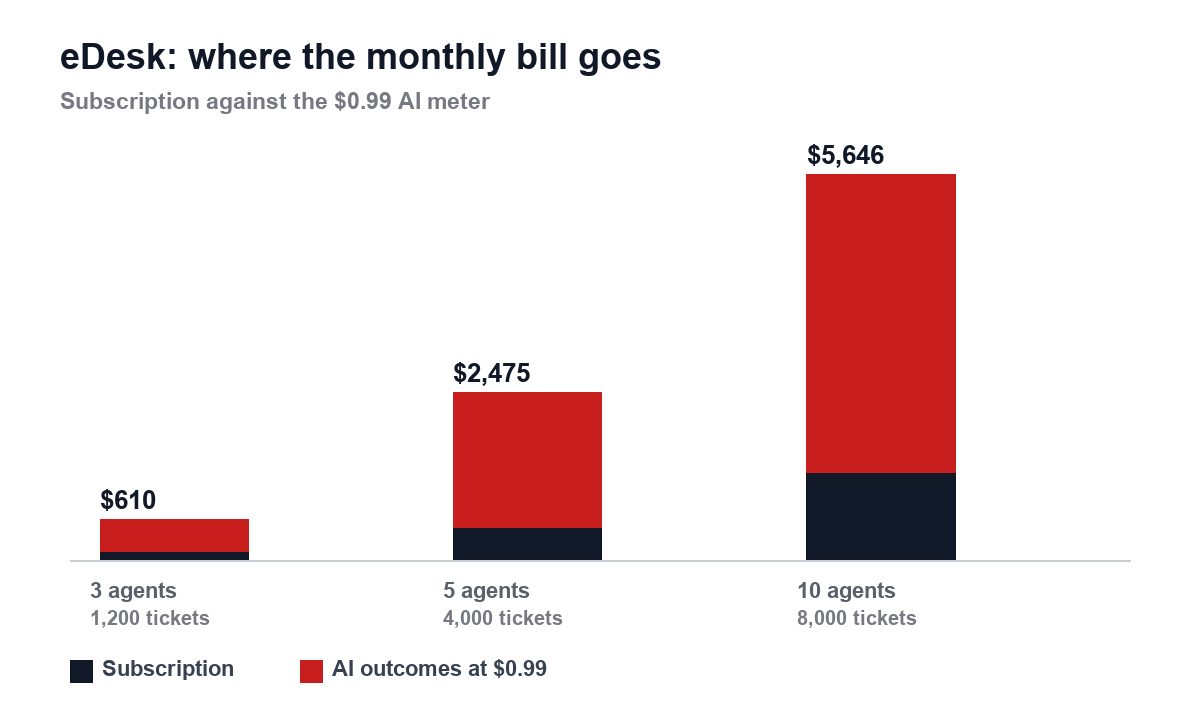
    Three agents, one store, 1,200 tickets, 40% automation. Essential at $45 each is $135. That is 480 outcomes at $0.99, so $475. Total $610 a month. No add-ons needed at this size.

    Five agents, four stores, 4,000 tickets, 50% automation. You need Growth for the store count, so $495. Two thousand outcomes cost $1,980. Total $2,475. The AI bill is four times the subscription, and that ratio is the thing to model before you commit.

    Ten agents, eight stores, 8,000 tickets, 55% automation. Professional at $129 each is $1,290. Four thousand four hundred outcomes cost $4,356. Total $5,646 a month. At this point you are negotiating, not buying off a page.

    Which plan, by store count

    One storefront and fewer than four agents: Essential. The missing reporting hurts, but $45 versus $99 is a real difference for a small team that already knows its numbers.

    Two to five stores: Growth. You are paying $54 more per agent for the store slots and the reporting. Both matter once you are reconciling Amazon and eBay in the same inbox.

    Six to ten stores: Professional. The two free read-only users are a nice detail if you have a finance person or an agency looking in.

    More than ten, or multi-brand with separate workflows: Enterprise. Expect a quote, a minimum term, and a discount off list that depends on how many agents you commit to.

    Where the money leaks

    Per agent pricing punishes seasonal hiring. Four extra agents for December is $396 a month on Growth, and you cannot buy them for six weeks. Gorgias gives away 500 seats and charges by ticket instead, which is better for peak staffing and worse for volume.

    Automation is the second leak, but in the opposite direction. The more the AI resolves, the less you pay in agent seats over time. A store that automates 60% of 5,000 tickets needs three agents instead of six, and $297 instead of $594, while paying $2,970 in AI fees.

    Run those two numbers together before you pick a plan. The cheapest subscription is rarely the cheapest configuration.

    For reference, Gorgias’s own rates are the other half of this comparison, and they changed in November 2026.

    Is it cheaper than Gorgias?

    For marketplace sellers with three to six agents, yes, usually by $300 to $900 a month at the same automation rate. For a single Shopify store with a large support team, no. Gorgias gives seats away and eDesk charges for them.

    The other difference is channel depth rather than price. The full alternative comparison runs every tool through the same bill. Amazon and eBay are native here and bolted on there. If those channels are secondary, you are paying for depth you will not use.

    FAQ

    How much does eDesk cost per month?

    $45 to $129 per agent on annual billing, plus $0.99 per AI outcome. A three agent store with moderate automation lands near $610.

    Is there a free plan?

    No. There is a 14-day trial with full features and no card, then a 30-day guarantee after purchase.

    Does the AI Agent cost extra?

    It is on every plan, metered at $0.99 per resolved outcome. No allowance is included, and failed attempts are not charged.

    What counts as an outcome?

    One ticket the AI fully answered or acted on. Multiple messages in the same thread count once.

    Can I change plans mid-year?

    Yes, up or down, and the store limit is the binding constraint. Going from five to six stores forces the jump from Growth to Professional.

    Check the AI line before you commit

    The 14-day trial shows your real outcome volume. Multiply it by $0.99 and add the agent seats, then compare against whatever you pay today.

    See current eDesk pricing

    If your store is Shopify-first rather than marketplace-first, the Gorgias pricing breakdown is the closer comparison.

    More on the decision: best helpdesk software for ecommerce, and how per-ticket pricing compares to per-agent.

    Comparing this with Zendesk? Six Zendesk alternatives are priced on the same store here.

    Disclosure: this page may contain affiliate links in future. Prices checked November 10, 2026 and can change.

  • Gorgias vs Zendesk 2026: Per Ticket vs Per Agent, and Who Pays More

    Gorgias vs Zendesk 2026: Per Ticket vs Per Agent, and Who Pays More

    These two get compared constantly, usually by people who have already decided they need a helpdesk and are now picking a logo. The comparison that matters is not features. It is what each one charges you for.

    Gorgias bills by conversation. Zendesk bills by agent. That single difference decides which one is cheaper long before anyone opens a feature matrix.

    The two price sheets, side by side

    Zendesk, annual billing, per agent per month:

    Zendesk planPriceWhat it covers
    Support Team$19Email and ticketing, basic routing
    Suite Team$55Adds messaging, live chat, telephony and AI agents
    Suite Professional$115Adds copilot, app builder, skills based routing
    Suite EnterpriseCustomSecurity, governance, custom roles

    Prices move without notice. The live numbers sit on Gorgias’s pricing page; the bills above reflect what each vendor charges today.

    Gorgias, monthly billing, per conversation:

    Gorgias planPriceTicketsSeats
    Starter$40503
    Basic$90300500
    Pro$5502,000500
    Advanced$1,4305,000500

    Prices verified November 18, 2026. Zendesk figures are the annual rate, which carries a 20% discount. Monthly billing runs about a quarter higher.

    Four teams, four different answers

    Abstract pricing arguments go nowhere. Here is what each platform costs at four real team shapes, using the cheapest plan that fits.

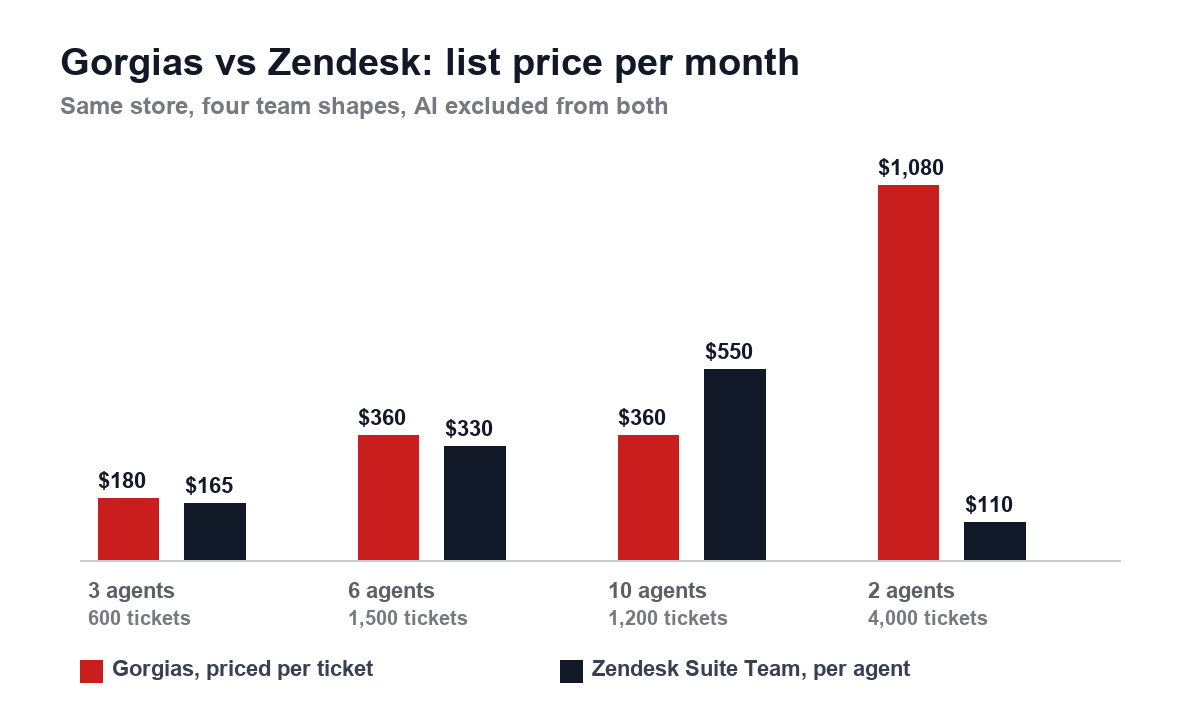
    Three agents, 600 tickets a month. Zendesk Suite Team is $165 at $55 a seat. Gorgias Basic is $90 and covers 300 tickets, so the other 300 cost $120 at $0.40. That is $210 before AI. At 40% automation the 240 agent conversations add $189. Gorgias lands at $399, and Zendesk wins by more than $200.

    Six agents, 1,500 tickets. Zendesk is $330. Gorgias Pro is $550 with the AI Agent and the ticket allowance covers all 1,500. The AI allowance does not: 600 conversations against 190 included leaves 410 at $0.90, or $369. Total $919. Zendesk wins by $589.

    Ten agents, 1,200 tickets. Zendesk crosses $550. Gorgias Pro is $550 plus 290 conversations over the AI allowance, which is $261. Total $811. Zendesk still wins, by $261. This is the case that flipped once the AI Agent became a separate $190 add-on, because the bare $360 Pro plan carries no AI conversations.

    Two agents, 4,000 tickets. Zendesk Suite Team is $110. Gorgias Pro covers 2,000 tickets and charges $0.36 on the rest, which is $720. At 40% automation there are 1,600 agent conversations, 1,410 over the allowance, so $1,269. Gorgias costs $2,539. Zendesk wins by a wide margin, and Advanced at $2,340 is still worse than Zendesk.

    The pattern is simple. Small team, high volume: Zendesk. Larger team, moderate volume: Gorgias. The break even sits around six or seven agents at 1,500 tickets, and it moves with your hiring plan.

    Gorgias and Zendesk monthly cost at four team sizes
    The cheaper tool flips somewhere between six and ten agents.

    What Zendesk is actually better at

    Zendesk has been building for enterprise support since 2007. The depth shows in places Gorgias does not compete. Custom roles, approval workflows, sandbox environments, voice with IVR trees, and a marketplace of integrations that covers almost any internal system.

    If your support team answers to a compliance officer, or you need SSO with SCIM across five business units, Zendesk is the safer conversation internally. Nobody gets fired for buying Zendesk.

    The catch is implementation. Zendesk arrives as a toolkit, not a finished workflow. Most teams need a consultant or a few weeks of internal work before the ticket flow matches how they actually operate. That cost never appears on the pricing page.

    What Gorgias does that Zendesk cannot copy quickly

    Gorgias was built inside Shopify. A ticket opens with the customer’s order history already attached, and the agent can refund, reship, or cancel without leaving the page. On Zendesk that data lives in a sidebar app, and the app is only as good as the integration.

    Setup reflects that. A Shopify store can be live in an afternoon, and the AI Agent starts answering order status questions the same week. Zendesk takes longer because there is more to configure, which is also why it scales further.

    The costs neither page mentions

    On Gorgias, the AI Agent is a separate add-on, $190 a month on Pro, metered on top of that. Pro includes 190 automated conversations within its $550, and each one past that costs $0.90. A store on Pro with 2,000 tickets at 40% automation runs 800 conversations, so 610 are billable at $549. The plan fee is about half the bill now, not a third.

    On Zendesk, the hidden cost is people. More agents means more money, and the platform is priced so that adding a seasonal hire in December is a real line item. If you run lean and let AI handle volume, the per agent model punishes you less. If you staff up for peak, it punishes you twice.

    Which one to pick

    Shopify or DTC, five to fifteen agents, support questions mostly about orders and returns. Gorgias is still the better product here, but it is no longer the cheaper one at these volumes. Buy it for the order data sitting inside the ticket, and budget $919 at 1,500 tickets rather than the $360 an older review would have quoted.

    Two to four agents handling heavy volume, or a support org inside a larger company with compliance and security reviews. Take Zendesk. Its $55 per seat now beats Gorgias at every shape in the table above, and the platform will not block you at 5,000 tickets.

    Marketplace sellers, meaning Amazon and eBay first and your own store second. That case is covered in the eDesk pricing breakdown. Neither of these is the obvious answer. eDesk was built for that shape and prices accordingly, which is a separate comparison.

    The switching cost nobody budgets for

    Whichever platform you leave, the migration is the expensive part. Ticket history, macros, saved replies, routing rules, and the reporting your manager already trusts. None of it moves cleanly between two systems built on different data models.

    In practice, teams that switch run both platforms for a month. Old tickets stay where they are, new ones start fresh, and the reporting is wrong for a quarter. If you are choosing between these two for the first time, that cost does not apply. The plan-by-plan pricing covers the ticket tiers in more detail. If you are switching, add four to six weeks of someone’s attention before you compare subscription prices.

    One more thing about renewals. Both companies discount the first year more than they admit, and both raise the rate at renewal. Gorgias tiers reward customer count, so a good affiliate or partner relationship can move you from 20% to 22% without changing anything about your traffic. Zendesk discounts come from sales, and they tend to reappear when you ask for a multi year term.

    FAQ

    Is Gorgias cheaper than Zendesk?

    At the four volumes above, no. Zendesk’s $55 per seat wins each comparison once the AI Agent add-on is counted. Gorgias only closes the gap when seats are high and ticket volume stays inside the allowance, which is a narrow shape.

    Does Zendesk charge per ticket?

    No. Zendesk charges per agent, and tickets are unlimited within the plan. That is the opposite of Gorgias, which charges per conversation and gives seats away.

    Can Zendesk handle Shopify orders?

    Yes, through integrations. It is not native the way Gorgias is. Agents usually end up with order data in a sidebar app rather than in the ticket itself.

    Which is faster to set up?

    Gorgias, by a wide margin, because it assumes you are on Shopify. Zendesk setup is closer to a project than a task.

    What about AI costs?

    Gorgias sells the AI Agent as an add-on, from $30 to $530, and charges $0.85 to $1.00 per automated conversation past the allowance. Zendesk bundles AI agents into Suite Team and above, which is cheaper at low volume and can get expensive as seats grow.

    Run your own numbers before you commit

    The Gorgias trial shows your real ticket count and how much of it the AI closes. Compare that to your agent headcount before you sign either contract.

    Start the Gorgias free trial

    Also worth reading: seven alternatives to Gorgias and the full comparison for ecommerce stores.

    Disclosure: this page contains affiliate links. If you start a paid Gorgias plan through one of them, we earn a commission at no extra cost to you. Prices checked November 9, 2026 and can change.

  • Gorgias Pricing 2026: Four Plans and the AI Fee Inside Them

    Gorgias Pricing 2026: Four Plans and the AI Fee Inside Them

    Gorgias shows four plan prices and one add-on. The add-on is the AI Agent, and it costs $30 to $530 a month depending on plan. Plan cards usually show the total with the agent included, which is why the same plan can look like two different prices depending on where you read it.

    This page rebuilds the bill from the rates Gorgias publishes today. All figures were read from the pricing page on November 18, 2026, and applied to the same reference store: three seats, 40% of conversations handled by the agent.

    The four plans, as they are priced now

    PlanWithout AIWith AI AgentHelpdesk lineAI Agent lineTicketsAI includedExtra ticketExtra AI
    Starter$10$40$10$305030$0.40$1.00
    Basic$60$90$60$3030030$0.40$0.90
    Pro$360$550$360$1902,000190$0.36$0.90
    Advanced$900$1,430$900$5305,000530$0.36$0.85

    If you want the current numbers straight from the source, Gorgias lists every plan and the AI add-on on its pricing page.

    Both numbers are real. Pro is $360 without the agent and $550 with it. The $190 is a fixed monthly fee, not a usage charge, so it is the first thing to decide before comparing plans. If you do not plan to let the agent resolve conversations, $360 is the number that applies.

    Annual billing is cheaper and is shown behind a toggle on Gorgias’s site. We have not quoted annual figures here because the page only renders monthly rates until that toggle is switched, and a number we cannot see is a number we will not print.

    Where one plan becomes cheaper than the next

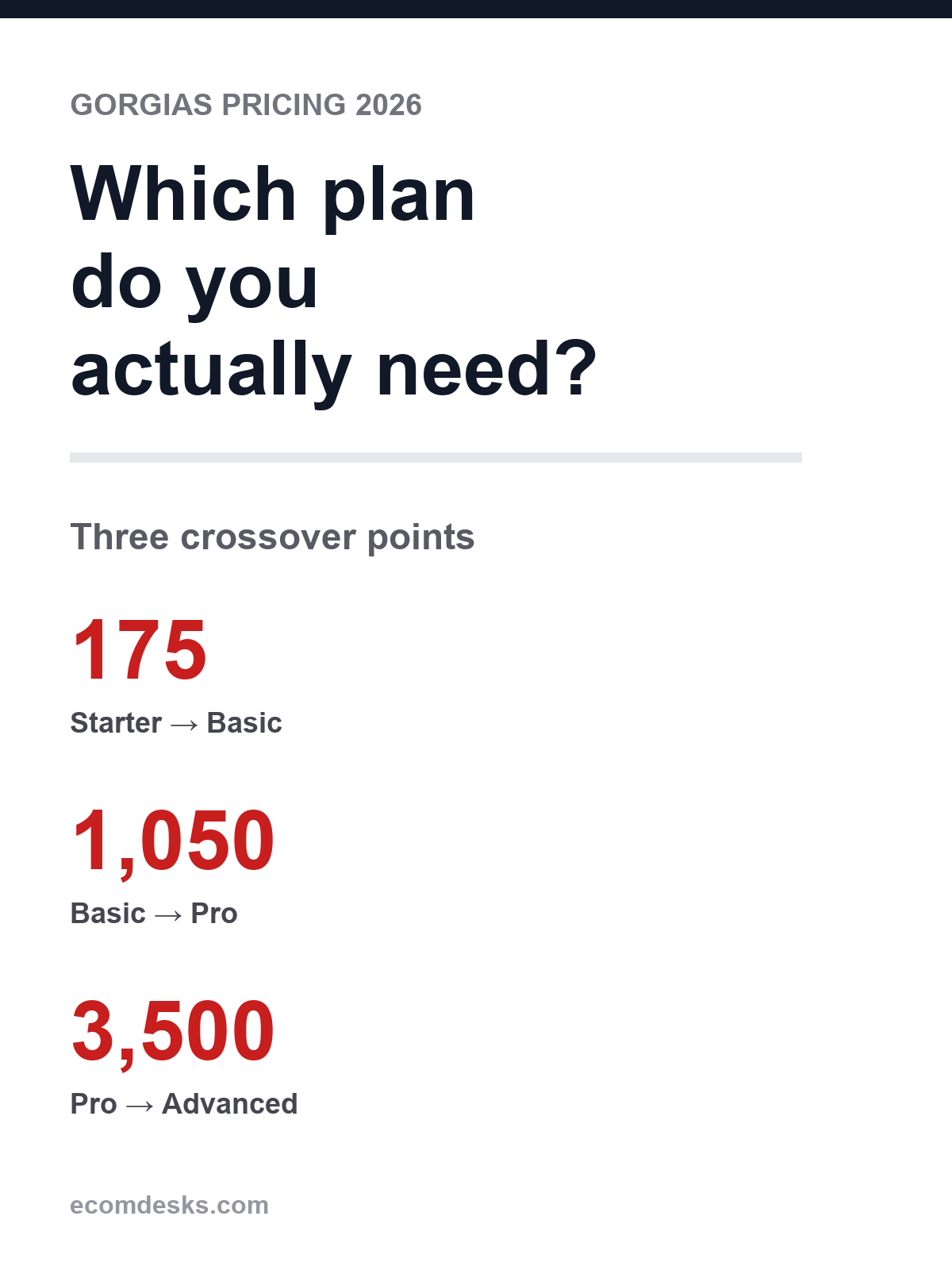
    Three crossover points decide most of this. They assume the plan price without the AI Agent and ignore AI overage, so treat them as the floor.

    Monthly ticketsCheapest planMonthlyWhy
    Under 175Starter$40 to $9050 tickets plus $0.40 overage still beats Basic
    175 to 1,450Basic$90 to $550300 tickets plus $0.40 overage
    1,450 to 4,444Pro$550 to $1,4302,000 tickets at the lower $0.36 rate
    Over 4,444Advanced$1,430 and up5,000 tickets before overage starts

    Add automation and the boundaries move inward, because a cheaper plan also has a smaller AI allowance. At 40% automation, Basic beats Starter at about 165 tickets, Pro beats Basic at roughly 1,090, and Advanced beats Pro near 3,470.

    That last shift is the one people miss. Advanced looks like an enterprise plan until you work out that at 3,500 tickets on Pro you are already paying $2,179 with overage, which is more than the Advanced list price.

    How the AI meter works

    An automated interaction is a conversation the agent closes without a human. If the agent drafts and a person edits and sends, that is a handled ticket, not an automated interaction. The distinction matters because the two meters move at different speeds: tickets follow order volume, automated interactions follow order volume multiplied by how much you let the agent finish on its own.

    The allowance is small. Pro includes 190 automated interactions against 2,000 tickets, under 10%. Basic includes 30. At 40% automation you are over the allowance on every plan except Advanced, which is why the AI overage shows up on almost every real bill.

    Overage is $1.00 per interaction on Starter, $0.90 on Basic and Pro, and $0.85 on Advanced. There is no volume break within a plan, so the 200th extra interaction costs the same as the 900th.

    Three bills at 40% automation

    StoreTicketsAI conversationsPlan that fitsMonthly bill
    New store, one person300120Basic$171
    Growing brand, three people1,200480Pro$811
    Multi-channel brand4,0001,600Advanced$2,340

    Two of the three land on a plan that is cheaper than the tier below, once overage is counted. At 1,200 tickets, Basic would cost $855 against $811 on Pro. At 4,000 tickets, Pro would cost $2,539 against $2,340 on Advanced.

    That is the practical rule for this pricing: compare the bill at your volume, not the plan name at your headcount. If the plan still looks wrong for your volume, seven alternatives are priced on one store.

    Where the bill moves most

    Automation rate. Moving the same 1,500 tickets from 20% to 60% automation adds $540 a month on Pro. Nothing about your order volume changed.

    Seasonality. A store doing 400 tickets for nine months and 3,000 in three peak months pays $8,892 a year on Basic against $10,407 on Pro, because the flat Pro fee is wasted in the quiet months.

    Seats do not move it. Every plan except Starter includes 500 seats, so a team of three and a team of fifteen pay the same unless the ticket count differs. For the per-seat model this replaces, Gorgias vs Zendesk runs the same arithmetic.

    Questions people ask before signing

    Does Gorgias charge per agent? No. It charges per ticket, and every plan above Starter includes 500 seats.

    What happens if I exceed the ticket allowance? You pay per ticket: $0.40 on Starter and Basic, $0.36 on Pro and Advanced. Up to the crossover points above, overage is cheaper than upgrading.

    Is the AI Agent included? Yes, as a line item in the plan price. The allowance is 30 interactions on Starter and Basic, 190 on Pro, 530 on Advanced. Past that it is $0.85 to $1.00 each depending on plan.

    Is annual billing worth it? It is cheaper, and the page only shows monthly rates until you switch the toggle. Measure a full month of tickets and automation first, then price the year.

    What changed, and why older numbers are wrong

    Earlier versions of this page quoted $10, $60, $360 and $900, with AI overage at $1.50 per interaction. Those were the helpdesk prices, and the AI fee sat outside the plan.

    Gorgias now sells the agent as a line of its own. The four helpdesk prices did not move, which is why older reviews still look right at a glance. What is new is the add-on: $30 on Starter and Basic, $190 on Pro, $530 on Advanced.

    Overage also fell, from $1.50 to $0.90 on Basic and Pro, and $0.85 on Advanced. Heavy users pay less per interaction than before. Everyone pays more before they send anything.

    Bottom line

    Budget from the total column, not the plan column. For the reference store at 1,500 tickets and 40% automation that means $919 on Pro, and any number below that is a quote for a different volume. The wider list of seven tools puts those bills side by side.

    If you want the full assessment of whether the product earns that bill, the Gorgias review covers what works, what does not, and what leaving costs.

    Prices read from Gorgias’s public pricing page on November 18, 2026. Bills are calculated from published rates, not from an account we ran.

    Disclosure: some links on this site are affiliate links. If you start a paid plan through one, the vendor pays a commission at no extra cost to you.

    Check Gorgias’s current plans

EcomDesks ยท Independent reviews of ecommerce support and operations software

Home · About · Alex Mercer · Contact · Privacy