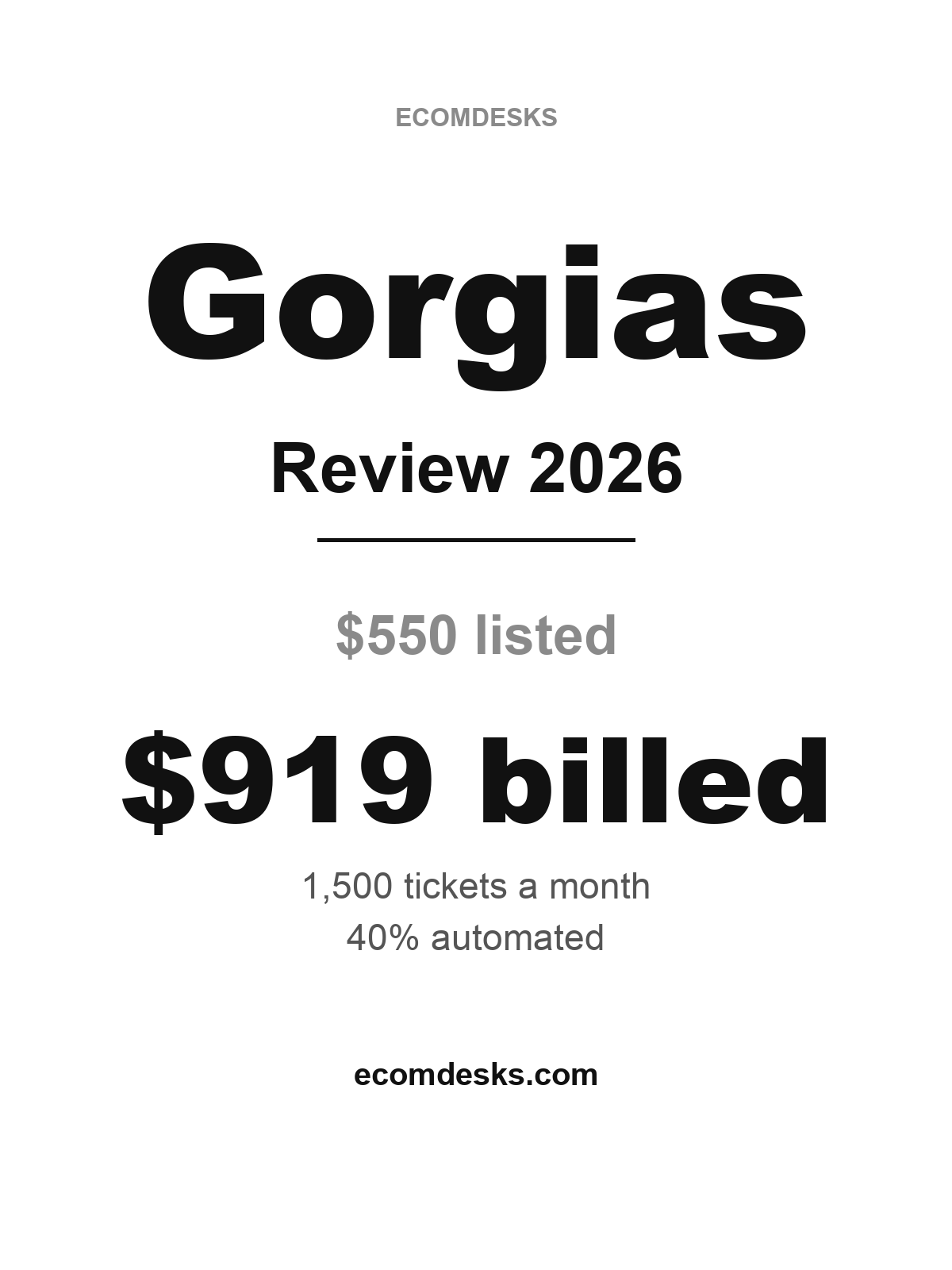
Gorgias changed how it sells in 2026. The helpdesk price is no longer the bill. The AI Agent is now a separate add-on with its own monthly fee, and it is metered on top of that. At the reference store used across this site, three seats and 1,500 tickets a month, the Pro plan costs $919, not the $550 on the pricing page.
That gap is the whole review. The plan is fine. The add-on is what you have to budget for.
On this page: Plans · Bills by volume · The AI variable · What works · When to leave · Verdict
Quick comparison
| Plan | Monthly with AI | Tickets | AI interactions | Extra ticket | Extra AI |
|---|---|---|---|---|---|
| Starter | $40 | 50 | 30 | $0.40 | $1.00 |
| Basic | $90 | 300 | 30 | $0.40 | $0.90 |
| Pro | $550 | 2,000 | 190 | $0.36 | $0.90 |
| Advanced | $1,430 | 5,000 | 530 | $0.36 | $0.85 |
The live numbers, including the AI add-on, are on Gorgias’s pricing page.
Prices read from Gorgias’s pricing page on November 18, 2026. Each figure above is the helpdesk line plus the AI Agent line. Without the agent the same four plans are $10, $60, $360 and $900.
How this was researched
This is a pricing review, not a hands-on trial. I did not run a Gorgias trial for this piece, so there are no screenshots of a live inbox and no claims about how the AI writes replies.
What I did was read the public pricing page, copy every plan limit and overage rate, then rebuild the same reference store in each plan. That store has three seats, 1,500 tickets a month and 40% of conversations handled by the AI Agent. Every dollar figure below comes from Gorgias’s own published rates applied to that store.
What changed in the 2026 pricing
Three things moved.
The plan price now includes an AI Agent fee. Starter is $10 for the helpdesk plus $30 for the agent. Pro is $360 plus $190. Advanced is $900 plus $530. If you already budgeted from older numbers, your bill went up by the second number.
Automated interactions are metered separately from tickets. Each plan includes a small allowance, from 30 on Starter to 530 on Advanced, and every interaction past that is charged per use. The rate runs from $1.00 down to $0.85 depending on plan.
Ticket overage is now quoted per hundred. Basic is $40 per 100 extra tickets, which is the same $0.40 per ticket as before. Pro and Advanced are $36 per hundred, or $0.36 each.
The bill at four volumes
Same store, same 40% automation, different monthly ticket counts. The cheapest plan at each volume is in the last column.
| Tickets | AI interactions | Starter | Basic | Pro | Advanced | Cheapest |
|---|---|---|---|---|---|---|
| 300 | 120 | $230 | $171 | $550 | $1,430 | Basic |
| 800 | 320 | $630 | $551 | $667 | $1,430 | Basic |
| 1,500 | 600 | $1,190 | $1,083 | $919 | $1,490 | Pro |
| 3,000 | 1,200 | $2,390 | $2,223 | $1,819 | $2,000 | Pro |
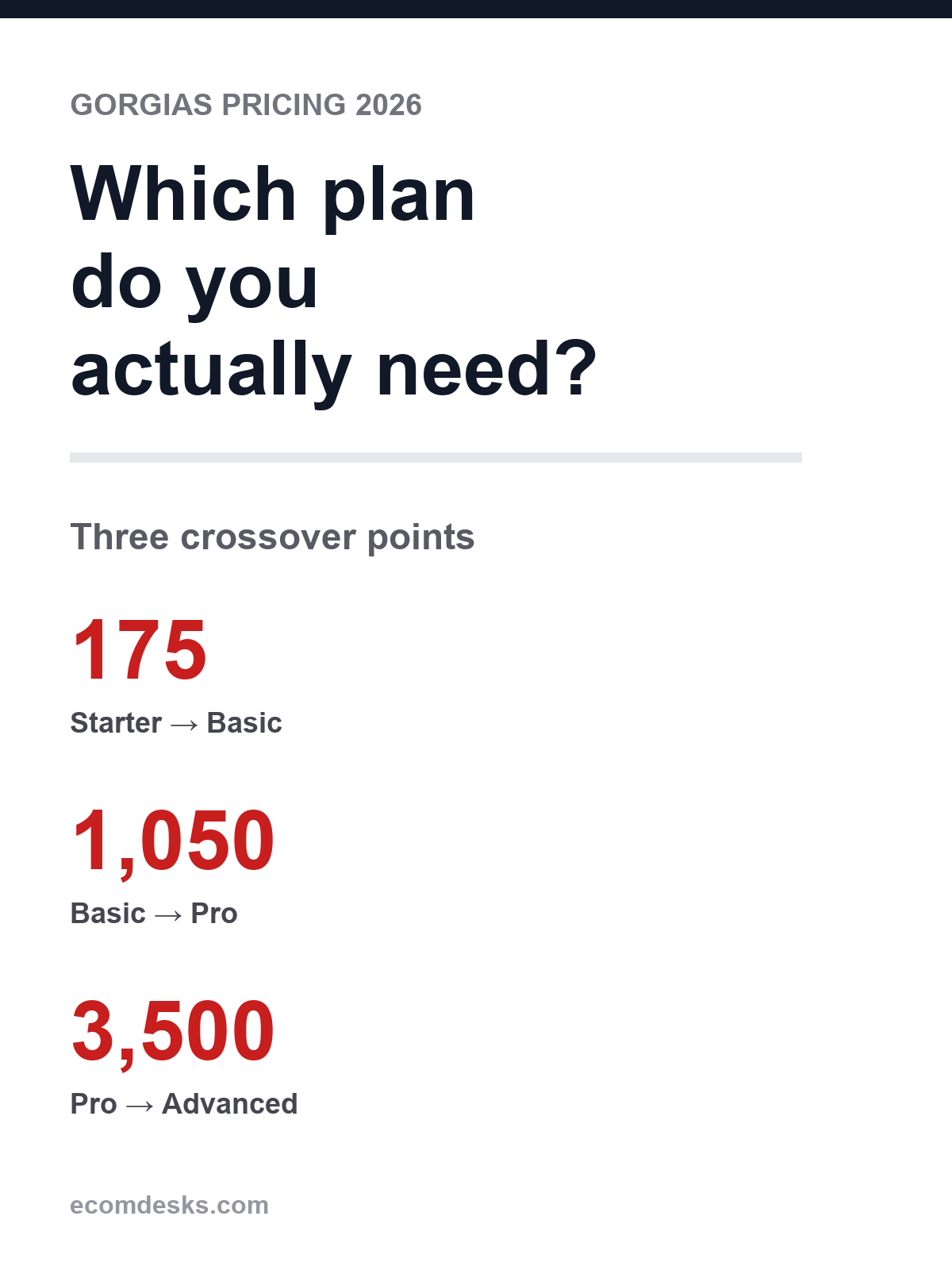
Three crossovers matter once AI is counted. Basic beats Starter at about 165 tickets. Pro beats Basic at roughly 1,090. Advanced only wins past 3,470, which is about where a store starts fielding 1,400 automated conversations a month.
What counts as an automated interaction
This is the line item most people misread. An automated interaction is a conversation the AI Agent resolves on its own. A ticket the AI drafts a reply for, which a human then edits and sends, is still a ticket, not an automated interaction.
That distinction matters because the two meters run at different speeds. Tickets scale with order volume. Automated interactions scale with order volume multiplied by how much you trust the AI. A store that reviews every AI draft pays for tickets and almost no AI usage. A store that lets the agent close refund requests pays for both.
The allowance is small relative to volume. Pro includes 190 automated interactions against 2,000 tickets, under 10%. Basic includes 30. If your automation rate lands anywhere near 40%, you will be paying overage on every plan below Advanced.
Seats stopped being the constraint
Every plan except Starter includes 500 seats. For an ecommerce support team of three to fifteen people, that is not a limit you will hit. It also means the old advice about buying seats in blocks no longer applies.
What replaced it is the ticket count. Two stores with the same headcount can land on different plans purely because one sells more orders. That is the trade Gorgias made when it moved off seat pricing, and for seasonal stores it usually works in your favour.
Three store profiles
Abstract volumes are hard to map onto a real business. Here are three stores at 40% automation, priced on the plan that fits each.
| Store | Monthly tickets | Best plan | Monthly bill | Per ticket |
|---|---|---|---|---|
| New Shopify store, one person on support | 300 | Basic | $171 | $0.57 |
| Growing brand, three people | 1,500 | Pro | $919 | $0.61 |
| Multi-channel brand, peak season | 3,000 | Pro | $1,819 | $0.61 |
The per-ticket cost is remarkably flat once you are past Basic. That is the useful takeaway. Gorgias does not get cheaper per ticket as you grow, it stays around sixty cents. If a competitor quotes you a lower per-ticket figure, check what it excludes.
Four questions before you sign
Ask these in writing. The answers change the bill more than any feature comparison.
First, what happens to unused tickets at the end of the month. On usage pricing, a quiet month should cost less. Confirm that it does and that overage is not billed in blocks you cannot use.
Second, does an AI draft that a human rewrites count as automated. If it does, your effective rate is higher than the dashboard suggests.
Third, what the annual discount is. Gorgias lists monthly pricing on the page and annual pricing behind a toggle. The gap is usually worth a phone call if you are committing to a year.
Fourth, whether the AI rate is locked. Per-interaction pricing at $0.90 is a published rate, not a contract term, and published rates have changed once already this year.
AI is the real variable
The plan comparison above assumes 40% automation. Change that assumption and the winner changes with it.
| Automation | AI interactions | Pro bill | Advanced bill |
|---|---|---|---|
| 20% | 300 | $649 | $1,430 |
| 40% | 600 | $919 | $1,490 |
| 60% | 900 | $1,189 | $1,745 |
At 1,500 tickets, moving from 20% to 60% automation adds $540 a month. The pitch for AI is that it replaces human replies. On this pricing, it also adds a usage line that grows with every conversation it handles.
That is not a trick. It is how usage pricing works. But it means the number you should model is not the ticket count. It is the ticket count multiplied by the automation rate you actually hit.
What Gorgias does well
The per-ticket model is still the right shape for ecommerce. A store with a quiet January and a brutal November pays for the tickets it gets. Seat-based competitors charge the same in both months.
Shopify integration is native rather than bolted on. Order data, refunds, and customer history sit inside the ticket, which is the thing most generic helpdesks still fail at.
Overage is predictable. At $0.40 or $0.36 per ticket, a spike of 500 tickets costs $180 to $200. That is knowable in advance, which is more than most seat-based plans can say.
When Gorgias stops making sense
Three signals, in order of how often they show up.
Your automation rate is high and your ticket count is low. At 800 tickets and 60% automation you are paying for AI interactions that a cheaper plan would bundle. The Pro add-on only pays off when ticket volume is there to absorb the AI fee.
You sell on more than one platform and support is split. Gorgias is strongest on Shopify. A store running Shopify plus WooCommerce plus a marketplace usually ends up paying for the top plan to cover integrations it uses once a week.
Your ticket mix is mostly pre-sale questions. Gorgias is built for post-purchase support. If most of your volume is “does this fit my bike”, a lighter chat tool handles it for a fraction of $919.
For the same reference store priced across seven tools, see the alternatives comparison. The spread there runs from $50 to $891 a month, and the gap is almost entirely plan structure rather than features.
What leaving costs
Less than most people fear, with one exception.
Tickets and customers export as CSV. Macros and rules do not transfer, so budget a day to rebuild the twenty or so you actually use. Integrations get reconnected by hand.
The exception is history. If your support team searches old tickets to answer new ones, moving means losing that search until the new tool imports it. Ask any vendor for a sample import before you sign. Most will do it for a store your size.
The seasonal case breaks the rule
Most ecommerce stores are not flat across the year. Take a store doing 400 tickets for nine months and 3,000 in each of the three peak months, still at 40% automation.
| Plan | Nine quiet months | Three peak months | Year total |
|---|---|---|---|
| Basic | $247 each | $2,223 each | $8,892 |
| Pro | $550 each | $1,819 each | $10,407 |
Basic wins by $1,515 a year, despite losing badly in every peak month. The flat Pro fee is what does it. You pay $550 in February for a plan whose capacity you only need in November.
If your volume swings more than three to one between slow and peak months, price the year rather than the month. That single change is worth more than any negotiation.
Verdict: is Gorgias worth it
Yes at Pro, if two things are true. You sell mainly on Shopify, and you expect at least 1,500 tickets a month. At that volume Pro is $919 with 40% automation and the integration work is already done.
No at Starter or Basic, unless you are deliberately small. Basic at 1,500 tickets costs $1,083, which is $164 more than Pro for fewer included interactions. The cheaper plan is the more expensive bill.
And no if your automation rate is above 60% on low volume. You are paying per interaction for something a flat-rate tool would include.
The bottom line
Budget $919 a month for the reference store, not $550. Check the automation rate before you pick a plan, because it moves the bill more than the ticket count does. And reread the pricing page before you sign, since the structure changed once already this year.
Prices in this article were read from Gorgias’s pricing page on November 18, 2026. No trial was run. Figures for other tools come from the linked comparison, which carries its own date.
Tools mentioned
- Gorgias, plans and metering as published on November 18, 2026
- Shopify, for the integration context
- WooCommerce, for the multi-platform case
- Zendesk Alternatives 2026: Six Options Priced on One Store
Related posts
- Gorgias Pricing 2026: Which Plan Fits Which Ticket Volume
- Gorgias Alternatives 2026: Seven Options and What Each Charges
- Gorgias vs Zendesk 2026: Per Ticket vs Per Agent
- Best Helpdesk Software for Ecommerce 2026
Disclosure: some links on this site are affiliate links. If you start a paid plan through one, the vendor pays a commission at no extra cost to you. It does not affect the numbers above, which come from published rates.