Tag: Gorgias

  • Gorgias Review 2026: What the Plan Really Costs

    Gorgias Review 2026: What the Plan Really Costs

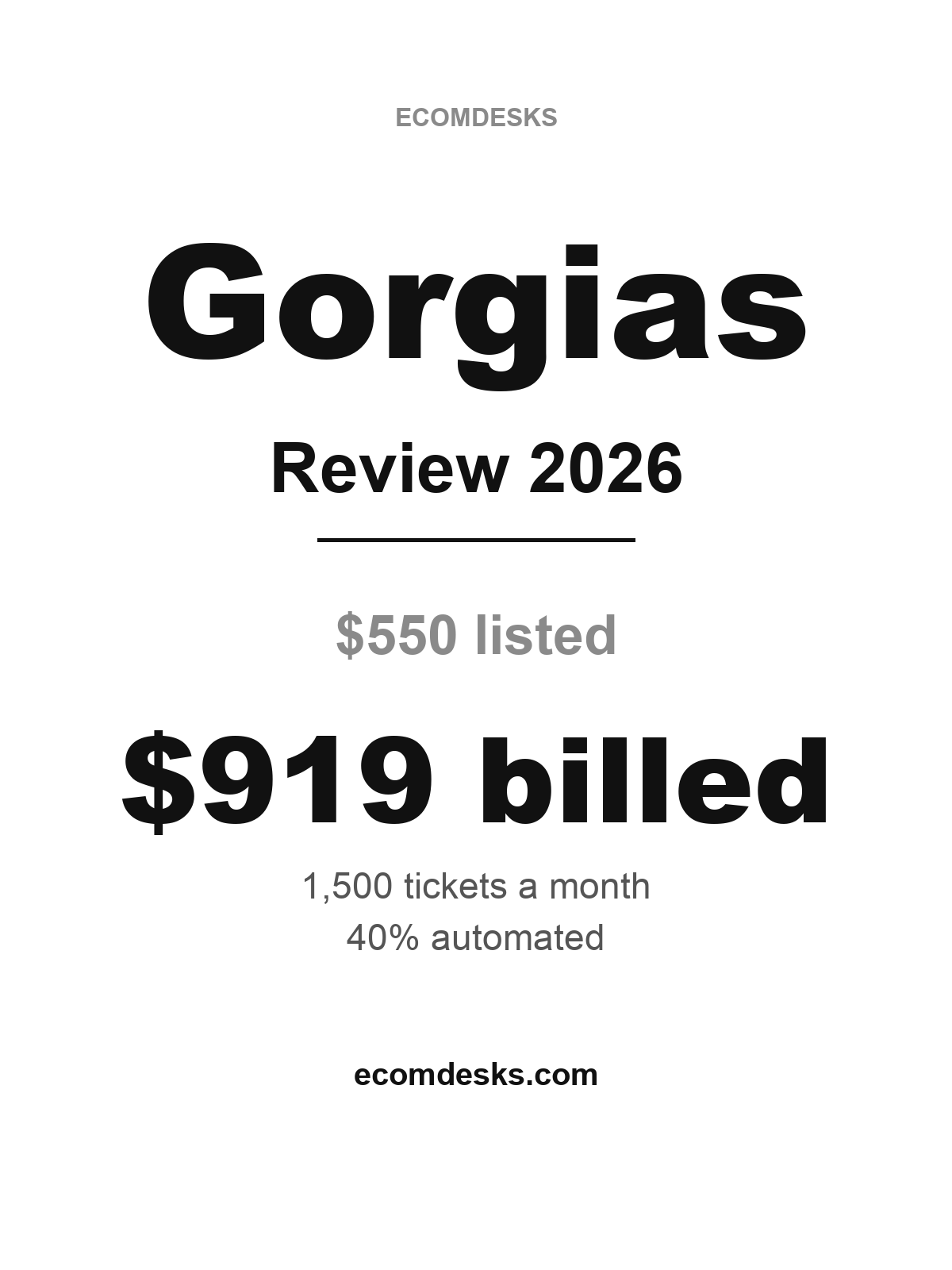
    Gorgias changed how it sells in 2026. The helpdesk price is no longer the bill. The AI Agent is now a separate add-on with its own monthly fee, and it is metered on top of that. At the reference store used across this site, three seats and 1,500 tickets a month, the Pro plan costs $919, not the $550 on the pricing page.

    That gap is the whole review. The plan is fine. The add-on is what you have to budget for.

    On this page: Plans · Bills by volume · The AI variable · What works · When to leave · Verdict

    Quick comparison

    PlanMonthly with AITicketsAI interactionsExtra ticketExtra AI
    Starter$405030$0.40$1.00
    Basic$9030030$0.40$0.90
    Pro$5502,000190$0.36$0.90
    Advanced$1,4305,000530$0.36$0.85

    The live numbers, including the AI add-on, are on Gorgias’s pricing page.

    Prices read from Gorgias’s pricing page on November 18, 2026. Each figure above is the helpdesk line plus the AI Agent line. Without the agent the same four plans are $10, $60, $360 and $900.

    How this was researched

    This is a pricing review, not a hands-on trial. I did not run a Gorgias trial for this piece, so there are no screenshots of a live inbox and no claims about how the AI writes replies.

    What I did was read the public pricing page, copy every plan limit and overage rate, then rebuild the same reference store in each plan. That store has three seats, 1,500 tickets a month and 40% of conversations handled by the AI Agent. Every dollar figure below comes from Gorgias’s own published rates applied to that store.

    What changed in the 2026 pricing

    Three things moved.

    The plan price now includes an AI Agent fee. Starter is $10 for the helpdesk plus $30 for the agent. Pro is $360 plus $190. Advanced is $900 plus $530. If you already budgeted from older numbers, your bill went up by the second number.

    Automated interactions are metered separately from tickets. Each plan includes a small allowance, from 30 on Starter to 530 on Advanced, and every interaction past that is charged per use. The rate runs from $1.00 down to $0.85 depending on plan.

    Ticket overage is now quoted per hundred. Basic is $40 per 100 extra tickets, which is the same $0.40 per ticket as before. Pro and Advanced are $36 per hundred, or $0.36 each.

    The bill at four volumes

    Same store, same 40% automation, different monthly ticket counts. The cheapest plan at each volume is in the last column.

    TicketsAI interactionsStarterBasicProAdvancedCheapest
    300120$230$171$550$1,430Basic
    800320$630$551$667$1,430Basic
    1,500600$1,190$1,083$919$1,490Pro
    3,0001,200$2,390$2,223$1,819$2,000Pro

    Three crossovers matter once AI is counted. Basic beats Starter at about 165 tickets. Pro beats Basic at roughly 1,090. Advanced only wins past 3,470, which is about where a store starts fielding 1,400 automated conversations a month.

    What counts as an automated interaction

    This is the line item most people misread. An automated interaction is a conversation the AI Agent resolves on its own. A ticket the AI drafts a reply for, which a human then edits and sends, is still a ticket, not an automated interaction.

    That distinction matters because the two meters run at different speeds. Tickets scale with order volume. Automated interactions scale with order volume multiplied by how much you trust the AI. A store that reviews every AI draft pays for tickets and almost no AI usage. A store that lets the agent close refund requests pays for both.

    The allowance is small relative to volume. Pro includes 190 automated interactions against 2,000 tickets, under 10%. Basic includes 30. If your automation rate lands anywhere near 40%, you will be paying overage on every plan below Advanced.

    Seats stopped being the constraint

    Every plan except Starter includes 500 seats. For an ecommerce support team of three to fifteen people, that is not a limit you will hit. It also means the old advice about buying seats in blocks no longer applies.

    What replaced it is the ticket count. Two stores with the same headcount can land on different plans purely because one sells more orders. That is the trade Gorgias made when it moved off seat pricing, and for seasonal stores it usually works in your favour.

    Three store profiles

    Abstract volumes are hard to map onto a real business. Here are three stores at 40% automation, priced on the plan that fits each.

    StoreMonthly ticketsBest planMonthly billPer ticket
    New Shopify store, one person on support300Basic$171$0.57
    Growing brand, three people1,500Pro$919$0.61
    Multi-channel brand, peak season3,000Pro$1,819$0.61

    The per-ticket cost is remarkably flat once you are past Basic. That is the useful takeaway. Gorgias does not get cheaper per ticket as you grow, it stays around sixty cents. If a competitor quotes you a lower per-ticket figure, check what it excludes.

    Four questions before you sign

    Ask these in writing. The answers change the bill more than any feature comparison.

    First, what happens to unused tickets at the end of the month. On usage pricing, a quiet month should cost less. Confirm that it does and that overage is not billed in blocks you cannot use.

    Second, does an AI draft that a human rewrites count as automated. If it does, your effective rate is higher than the dashboard suggests.

    Third, what the annual discount is. Gorgias lists monthly pricing on the page and annual pricing behind a toggle. The gap is usually worth a phone call if you are committing to a year.

    Fourth, whether the AI rate is locked. Per-interaction pricing at $0.90 is a published rate, not a contract term, and published rates have changed once already this year.

    AI is the real variable

    The plan comparison above assumes 40% automation. Change that assumption and the winner changes with it.

    AutomationAI interactionsPro billAdvanced bill
    20%300$649$1,430
    40%600$919$1,490
    60%900$1,189$1,745

    At 1,500 tickets, moving from 20% to 60% automation adds $540 a month. The pitch for AI is that it replaces human replies. On this pricing, it also adds a usage line that grows with every conversation it handles.

    That is not a trick. It is how usage pricing works. But it means the number you should model is not the ticket count. It is the ticket count multiplied by the automation rate you actually hit.

    What Gorgias does well

    The per-ticket model is still the right shape for ecommerce. A store with a quiet January and a brutal November pays for the tickets it gets. Seat-based competitors charge the same in both months.

    Shopify integration is native rather than bolted on. Order data, refunds, and customer history sit inside the ticket, which is the thing most generic helpdesks still fail at.

    Overage is predictable. At $0.40 or $0.36 per ticket, a spike of 500 tickets costs $180 to $200. That is knowable in advance, which is more than most seat-based plans can say.

    When Gorgias stops making sense

    Three signals, in order of how often they show up.

    Your automation rate is high and your ticket count is low. At 800 tickets and 60% automation you are paying for AI interactions that a cheaper plan would bundle. The Pro add-on only pays off when ticket volume is there to absorb the AI fee.

    You sell on more than one platform and support is split. Gorgias is strongest on Shopify. A store running Shopify plus WooCommerce plus a marketplace usually ends up paying for the top plan to cover integrations it uses once a week.

    Your ticket mix is mostly pre-sale questions. Gorgias is built for post-purchase support. If most of your volume is “does this fit my bike”, a lighter chat tool handles it for a fraction of $919.

    For the same reference store priced across seven tools, see the alternatives comparison. The spread there runs from $50 to $891 a month, and the gap is almost entirely plan structure rather than features.

    What leaving costs

    Less than most people fear, with one exception.

    Tickets and customers export as CSV. Macros and rules do not transfer, so budget a day to rebuild the twenty or so you actually use. Integrations get reconnected by hand.

    The exception is history. If your support team searches old tickets to answer new ones, moving means losing that search until the new tool imports it. Ask any vendor for a sample import before you sign. Most will do it for a store your size.

    The seasonal case breaks the rule

    Most ecommerce stores are not flat across the year. Take a store doing 400 tickets for nine months and 3,000 in each of the three peak months, still at 40% automation.

    PlanNine quiet monthsThree peak monthsYear total
    Basic$247 each$2,223 each$8,892
    Pro$550 each$1,819 each$10,407

    Basic wins by $1,515 a year, despite losing badly in every peak month. The flat Pro fee is what does it. You pay $550 in February for a plan whose capacity you only need in November.

    If your volume swings more than three to one between slow and peak months, price the year rather than the month. That single change is worth more than any negotiation.

    Verdict: is Gorgias worth it

    Yes at Pro, if two things are true. You sell mainly on Shopify, and you expect at least 1,500 tickets a month. At that volume Pro is $919 with 40% automation and the integration work is already done.

    No at Starter or Basic, unless you are deliberately small. Basic at 1,500 tickets costs $1,083, which is $164 more than Pro for fewer included interactions. The cheaper plan is the more expensive bill.

    And no if your automation rate is above 60% on low volume. You are paying per interaction for something a flat-rate tool would include.

    The bottom line

    Budget $919 a month for the reference store, not $550. Check the automation rate before you pick a plan, because it moves the bill more than the ticket count does. And reread the pricing page before you sign, since the structure changed once already this year.

    Prices in this article were read from Gorgias’s pricing page on November 18, 2026. No trial was run. Figures for other tools come from the linked comparison, which carries its own date.

    Tools mentioned

    Disclosure: some links on this site are affiliate links. If you start a paid plan through one, the vendor pays a commission at no extra cost to you. It does not affect the numbers above, which come from published rates.
    See Gorgias’s current plans and AI rates

  • Gorgias Alternatives 2026: Seven Options and What Each Charges

    Gorgias Alternatives 2026: Seven Options and What Each Charges

    Price update: Gorgias changed its plan structure in November 2026 and now sells an AI Agent add-on on every tier. The Gorgias review carries the current numbers and the recalculated bills.

    Gorgias is the default pick for Shopify brands, and its four plans are the baseline every option here gets measured against. That is also why people go looking for something else, usually right after the first invoice that includes AI.

    One detail explains most of it. Gorgias sells the AI Agent as an add-on, $30 on Starter and Basic up to $530 on Advanced, and charges $0.90 per conversation past the allowance. The plan price on the page is the floor, not the bill, and the difference shows up before you send a single ticket.

    Seven realistic alternatives, with what each one actually charges in November 2026. Prices pulled from each vendor’s own pricing page.

    The short list

    ToolPricing modelEntry priceBest for
    eDeskPer agent + $0.99 per AI outcome$45 per agentAmazon and eBay sellers
    RichpanelPer order volume$50 per monthShopify stores with steady volume
    Re:amazePer agent$29 per agentSmall teams that want depth cheap
    Help ScoutPer user$25 per userEmail-first support, no ecommerce
    ZendeskPer agent$19 per agentEnterprise and compliance
    IntercomPer seat + $0.99 per Fin outcome$29 per seatSales-led chat
    KustomerPer agent, 8 seat minimum$89 per agentLarge contact centers

    Every figure in this table came from the vendor’s own page. Gorgias is the one most readers end up measuring the rest against.

    Entry prices hide the real bill, which is why the next section runs the same store through each one.

    One store, seven bills

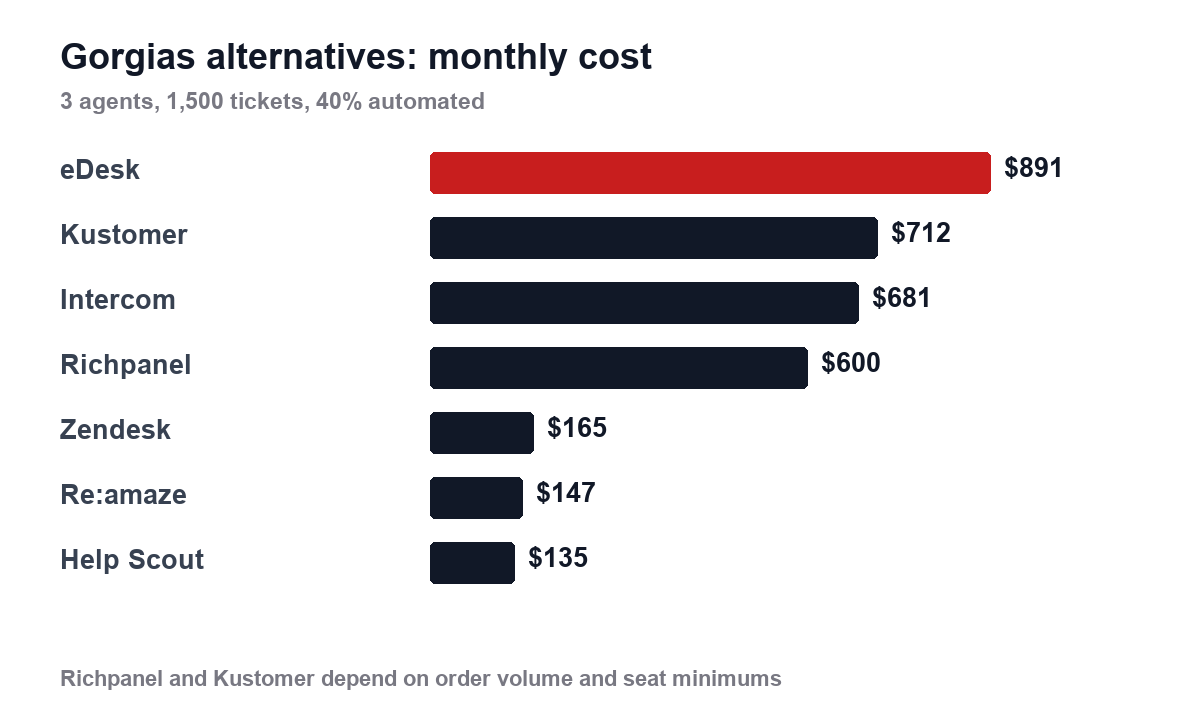
    Take a store with three agents, 1,500 tickets a month, and a 40% AI resolution rate. That is 600 automated conversations.

    ToolPlan usedSubscriptionAITotal per month
    Help ScoutPlus, annual$135Included at this volume$135
    Re:amazePro$147Included$147
    ZendeskSuite Team, annual$165Bundled$165
    RichpanelStarter$50Included$50 to $600
    IntercomEssential$87$594$681
    KustomerEnterprise, 8 seat floor$712Extra$712 and up
    eDeskGrowth, annual$297$594$891

    Two things jump out. The AI line is bigger than the subscription for every tool that meters it. And Richpanel’s price depends on order volume rather than headcount, so the same store can pay $50 or $600 without changing its team.

    eDesk

    The marketplace specialist, and the eDesk pricing page breaks down the AI meter. Amazon, eBay, Walmart, and Mirakl are native channels rather than integrations, which matters if half your volume arrives through them. Shopify and TikTok Shop work too, just as secondary channels.

    $45 to $129 per agent on annual billing, plus $0.99 per AI outcome. The AI only charges when it actually answers or acts, and a thread counts once no matter how many messages it takes. That is a fairer meter than most.

    Downside: per agent pricing punishes seasonal hiring, and the AI line is unbounded. At 600 outcomes a month the fee is $594, twice the subscription.

    Richpanel

    The only one on this list that does not charge per person. Plans are tied to order volume: free up to 50 orders a month, $50 for 500, $600 for 10,000. Add ten agents and the price does not move.

    For a Shopify store doing 2,000 to 5,000 orders a month with a growing team, that is the cheapest structure here by a wide margin. The catch is the cliffs. Cross 500 orders and you jump from $50 to the next tier, not a smooth increase.

    Re:amaze

    The value pick. $29 per agent on Basic, $49 on Pro, with annual billing shaving about 10%. It covers email, chat, social, and Shopify order data without the Gorgias premium.

    It looks dated next to Gorgias, and the AI is not close. But at $147 a month for three agents with AI included, it is a third of what the same team pays on eDesk with automation running.

    Help Scout

    Free for up to five users, then $25, $45, or $75 per user per month on annual billing. Built for email-first support teams, and it shows. The inbox is the best in this list to actually work in.

    What it does not do well: ecommerce. Order data lives in an integration, not in the ticket, and there is no marketplace support at all. If your questions are about shipping a physical product, this is the wrong shape.

    Zendesk

    $19 per agent for basic ticketing, $55 for the suite with messaging and voice, $115 for professional. Tickets are unlimited, which flips the math for high volume teams with few agents.

    The trade is setup time. Zendesk arrives as a toolkit, and the head-to-head comparison covers the cost at four team sizes. Expect weeks of configuration before it matches how your team already works, and budget for a consultant if nobody internal owns it.

    Intercom

    $29 per seat on Essential, $85 on Advanced, plus $0.99 per Fin outcome. The AI is the strongest in this group, and the price reflects it. A three agent team with 600 automated conversations pays $681 a month before add-ons.

    Worth it if support is a sales channel and chat drives revenue. Wasteful if you are answering where-is-my-order emails.

    Kustomer

    $89 per seat, annual contracts only, eight seat minimum. That is $712 a month before you answer a single ticket. Built for contact centers with thousands of conversations a day and a compliance team.

    If you are reading this list, you are probably not the buyer. Mentioned for completeness, because it shows up in every comparison and the price is usually buried.

    Monthly cost of seven Gorgias alternatives at three agents and 1,500 tickets
    Seven tools, seven bills, one store.

    What I would pick

    Shopify only, three to eight agents, mostly order questions: Richpanel if your order volume is predictable, Gorgias if you want the AI to sell as well as answer. Richpanel is cheaper, Gorgias is better at revenue.

    Amazon or eBay is a real channel: eDesk, without much debate. Nothing else on this list treats marketplace messaging as a first class citizen.

    Email-heavy, no product to ship: Help Scout. Small budget and you can live without polish: Re:amaze. Enterprise with auditors in the room: Zendesk.

    FAQ

    What is the cheapest Gorgias alternative?

    Help Scout at $25 per user on annual billing, or Re:amaze at $29 per agent. Neither handles ecommerce order data as well as Gorgias does.

    Which alternative has the best AI?

    Intercom’s Fin, then Gorgias. Both charge about $1 per resolved conversation, and both are more expensive than the tools that bundle a smaller allowance.

    Do any of these charge per ticket instead of per agent?

    Gorgias charges per ticket. Richpanel charges per order volume, which is a different meter again. The rest charge per agent or per seat.

    Can I switch from Gorgias without losing ticket history?

    History exports, but routing rules, macros, and reporting do not transfer cleanly. Plan on four to six weeks of parallel running, and keep the old account read-only for a quarter.

    Still the best fit for Shopify

    If the alternative you are considering is a cheaper way to handle order questions, the trial is still the fastest way to compare. Seven days, no card, real ticket volume.

    Start the Gorgias free trial

    Still deciding: seven ecommerce helpdesks priced on one store.

    Disclosure: this page contains affiliate links. Prices checked November 9 and 10, 2026 and can change. Some tools on this list do not have an affiliate program and are linked plainly.

  • Gorgias vs Zendesk 2026: Per Ticket vs Per Agent, and Who Pays More

    Gorgias vs Zendesk 2026: Per Ticket vs Per Agent, and Who Pays More

    These two get compared constantly, usually by people who have already decided they need a helpdesk and are now picking a logo. The comparison that matters is not features. It is what each one charges you for.

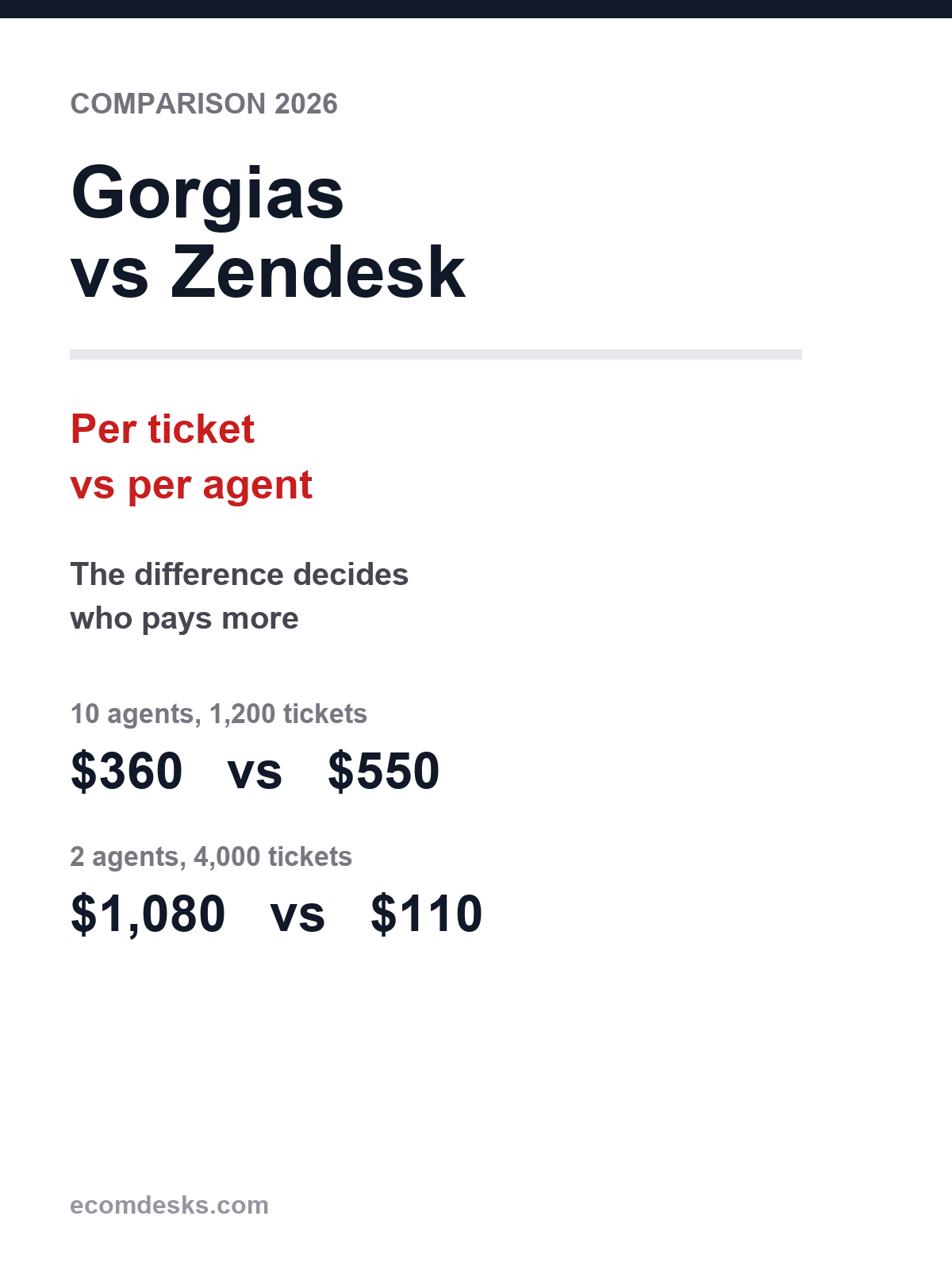
    Gorgias bills by conversation. Zendesk bills by agent. That single difference decides which one is cheaper long before anyone opens a feature matrix.

    The two price sheets, side by side

    Zendesk, annual billing, per agent per month:

    Zendesk planPriceWhat it covers
    Support Team$19Email and ticketing, basic routing
    Suite Team$55Adds messaging, live chat, telephony and AI agents
    Suite Professional$115Adds copilot, app builder, skills based routing
    Suite EnterpriseCustomSecurity, governance, custom roles

    Prices move without notice. The live numbers sit on Gorgias’s pricing page; the bills above reflect what each vendor charges today.

    Gorgias, monthly billing, per conversation:

    Gorgias planPriceTicketsSeats
    Starter$40503
    Basic$90300500
    Pro$5502,000500
    Advanced$1,4305,000500

    Prices verified November 18, 2026. Zendesk figures are the annual rate, which carries a 20% discount. Monthly billing runs about a quarter higher.

    Four teams, four different answers

    Abstract pricing arguments go nowhere. Here is what each platform costs at four real team shapes, using the cheapest plan that fits.

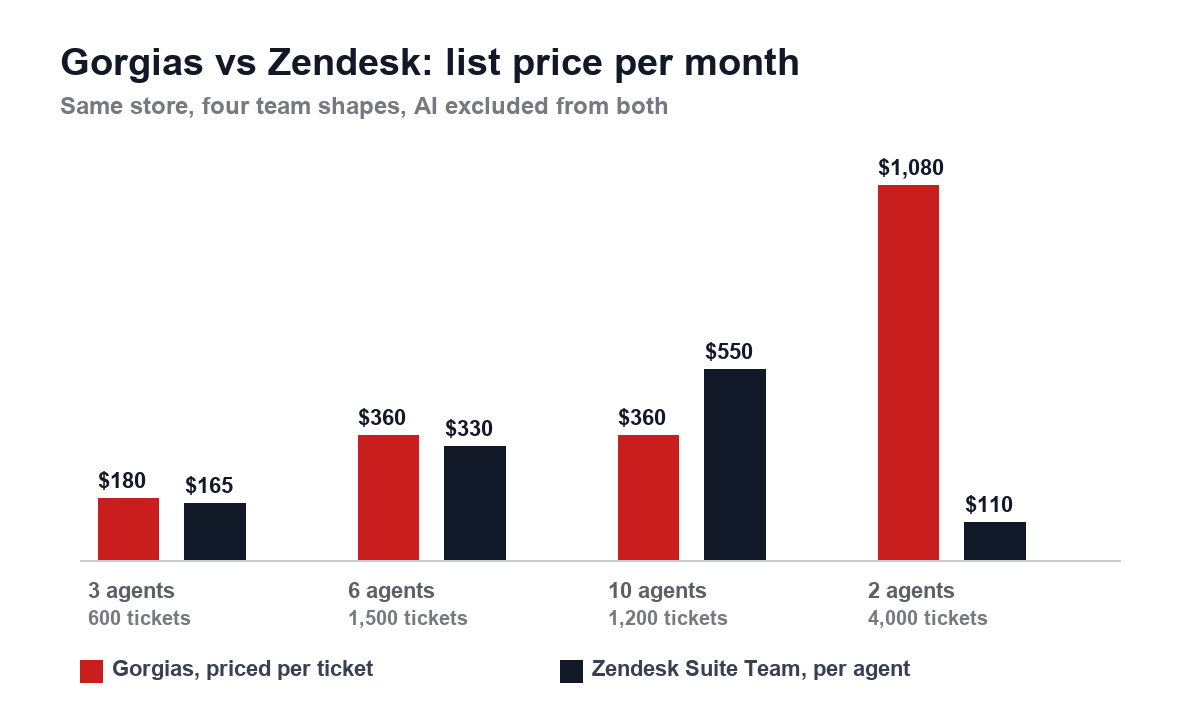
    Three agents, 600 tickets a month. Zendesk Suite Team is $165 at $55 a seat. Gorgias Basic is $90 and covers 300 tickets, so the other 300 cost $120 at $0.40. That is $210 before AI. At 40% automation the 240 agent conversations add $189. Gorgias lands at $399, and Zendesk wins by more than $200.

    Six agents, 1,500 tickets. Zendesk is $330. Gorgias Pro is $550 with the AI Agent and the ticket allowance covers all 1,500. The AI allowance does not: 600 conversations against 190 included leaves 410 at $0.90, or $369. Total $919. Zendesk wins by $589.

    Ten agents, 1,200 tickets. Zendesk crosses $550. Gorgias Pro is $550 plus 290 conversations over the AI allowance, which is $261. Total $811. Zendesk still wins, by $261. This is the case that flipped once the AI Agent became a separate $190 add-on, because the bare $360 Pro plan carries no AI conversations.

    Two agents, 4,000 tickets. Zendesk Suite Team is $110. Gorgias Pro covers 2,000 tickets and charges $0.36 on the rest, which is $720. At 40% automation there are 1,600 agent conversations, 1,410 over the allowance, so $1,269. Gorgias costs $2,539. Zendesk wins by a wide margin, and Advanced at $2,340 is still worse than Zendesk.

    The pattern is simple. Small team, high volume: Zendesk. Larger team, moderate volume: Gorgias. The break even sits around six or seven agents at 1,500 tickets, and it moves with your hiring plan.

    Gorgias and Zendesk monthly cost at four team sizes
    The cheaper tool flips somewhere between six and ten agents.

    What Zendesk is actually better at

    Zendesk has been building for enterprise support since 2007. The depth shows in places Gorgias does not compete. Custom roles, approval workflows, sandbox environments, voice with IVR trees, and a marketplace of integrations that covers almost any internal system.

    If your support team answers to a compliance officer, or you need SSO with SCIM across five business units, Zendesk is the safer conversation internally. Nobody gets fired for buying Zendesk.

    The catch is implementation. Zendesk arrives as a toolkit, not a finished workflow. Most teams need a consultant or a few weeks of internal work before the ticket flow matches how they actually operate. That cost never appears on the pricing page.

    What Gorgias does that Zendesk cannot copy quickly

    Gorgias was built inside Shopify. A ticket opens with the customer’s order history already attached, and the agent can refund, reship, or cancel without leaving the page. On Zendesk that data lives in a sidebar app, and the app is only as good as the integration.

    Setup reflects that. A Shopify store can be live in an afternoon, and the AI Agent starts answering order status questions the same week. Zendesk takes longer because there is more to configure, which is also why it scales further.

    The costs neither page mentions

    On Gorgias, the AI Agent is a separate add-on, $190 a month on Pro, metered on top of that. Pro includes 190 automated conversations within its $550, and each one past that costs $0.90. A store on Pro with 2,000 tickets at 40% automation runs 800 conversations, so 610 are billable at $549. The plan fee is about half the bill now, not a third.

    On Zendesk, the hidden cost is people. More agents means more money, and the platform is priced so that adding a seasonal hire in December is a real line item. If you run lean and let AI handle volume, the per agent model punishes you less. If you staff up for peak, it punishes you twice.

    Which one to pick

    Shopify or DTC, five to fifteen agents, support questions mostly about orders and returns. Gorgias is still the better product here, but it is no longer the cheaper one at these volumes. Buy it for the order data sitting inside the ticket, and budget $919 at 1,500 tickets rather than the $360 an older review would have quoted.

    Two to four agents handling heavy volume, or a support org inside a larger company with compliance and security reviews. Take Zendesk. Its $55 per seat now beats Gorgias at every shape in the table above, and the platform will not block you at 5,000 tickets.

    Marketplace sellers, meaning Amazon and eBay first and your own store second. That case is covered in the eDesk pricing breakdown. Neither of these is the obvious answer. eDesk was built for that shape and prices accordingly, which is a separate comparison.

    The switching cost nobody budgets for

    Whichever platform you leave, the migration is the expensive part. Ticket history, macros, saved replies, routing rules, and the reporting your manager already trusts. None of it moves cleanly between two systems built on different data models.

    In practice, teams that switch run both platforms for a month. Old tickets stay where they are, new ones start fresh, and the reporting is wrong for a quarter. If you are choosing between these two for the first time, that cost does not apply. The plan-by-plan pricing covers the ticket tiers in more detail. If you are switching, add four to six weeks of someone’s attention before you compare subscription prices.

    One more thing about renewals. Both companies discount the first year more than they admit, and both raise the rate at renewal. Gorgias tiers reward customer count, so a good affiliate or partner relationship can move you from 20% to 22% without changing anything about your traffic. Zendesk discounts come from sales, and they tend to reappear when you ask for a multi year term.

    FAQ

    Is Gorgias cheaper than Zendesk?

    At the four volumes above, no. Zendesk’s $55 per seat wins each comparison once the AI Agent add-on is counted. Gorgias only closes the gap when seats are high and ticket volume stays inside the allowance, which is a narrow shape.

    Does Zendesk charge per ticket?

    No. Zendesk charges per agent, and tickets are unlimited within the plan. That is the opposite of Gorgias, which charges per conversation and gives seats away.

    Can Zendesk handle Shopify orders?

    Yes, through integrations. It is not native the way Gorgias is. Agents usually end up with order data in a sidebar app rather than in the ticket itself.

    Which is faster to set up?

    Gorgias, by a wide margin, because it assumes you are on Shopify. Zendesk setup is closer to a project than a task.

    What about AI costs?

    Gorgias sells the AI Agent as an add-on, from $30 to $530, and charges $0.85 to $1.00 per automated conversation past the allowance. Zendesk bundles AI agents into Suite Team and above, which is cheaper at low volume and can get expensive as seats grow.

    Run your own numbers before you commit

    The Gorgias trial shows your real ticket count and how much of it the AI closes. Compare that to your agent headcount before you sign either contract.

    Start the Gorgias free trial

    Also worth reading: seven alternatives to Gorgias and the full comparison for ecommerce stores.

    Disclosure: this page contains affiliate links. If you start a paid Gorgias plan through one of them, we earn a commission at no extra cost to you. Prices checked November 9, 2026 and can change.

  • Gorgias Pricing 2026: Four Plans and the AI Fee Inside Them

    Gorgias Pricing 2026: Four Plans and the AI Fee Inside Them

    Gorgias shows four plan prices and one add-on. The add-on is the AI Agent, and it costs $30 to $530 a month depending on plan. Plan cards usually show the total with the agent included, which is why the same plan can look like two different prices depending on where you read it.

    This page rebuilds the bill from the rates Gorgias publishes today. All figures were read from the pricing page on November 18, 2026, and applied to the same reference store: three seats, 40% of conversations handled by the agent.

    The four plans, as they are priced now

    PlanWithout AIWith AI AgentHelpdesk lineAI Agent lineTicketsAI includedExtra ticketExtra AI
    Starter$10$40$10$305030$0.40$1.00
    Basic$60$90$60$3030030$0.40$0.90
    Pro$360$550$360$1902,000190$0.36$0.90
    Advanced$900$1,430$900$5305,000530$0.36$0.85

    If you want the current numbers straight from the source, Gorgias lists every plan and the AI add-on on its pricing page.

    Both numbers are real. Pro is $360 without the agent and $550 with it. The $190 is a fixed monthly fee, not a usage charge, so it is the first thing to decide before comparing plans. If you do not plan to let the agent resolve conversations, $360 is the number that applies.

    Annual billing is cheaper and is shown behind a toggle on Gorgias’s site. We have not quoted annual figures here because the page only renders monthly rates until that toggle is switched, and a number we cannot see is a number we will not print.

    Where one plan becomes cheaper than the next

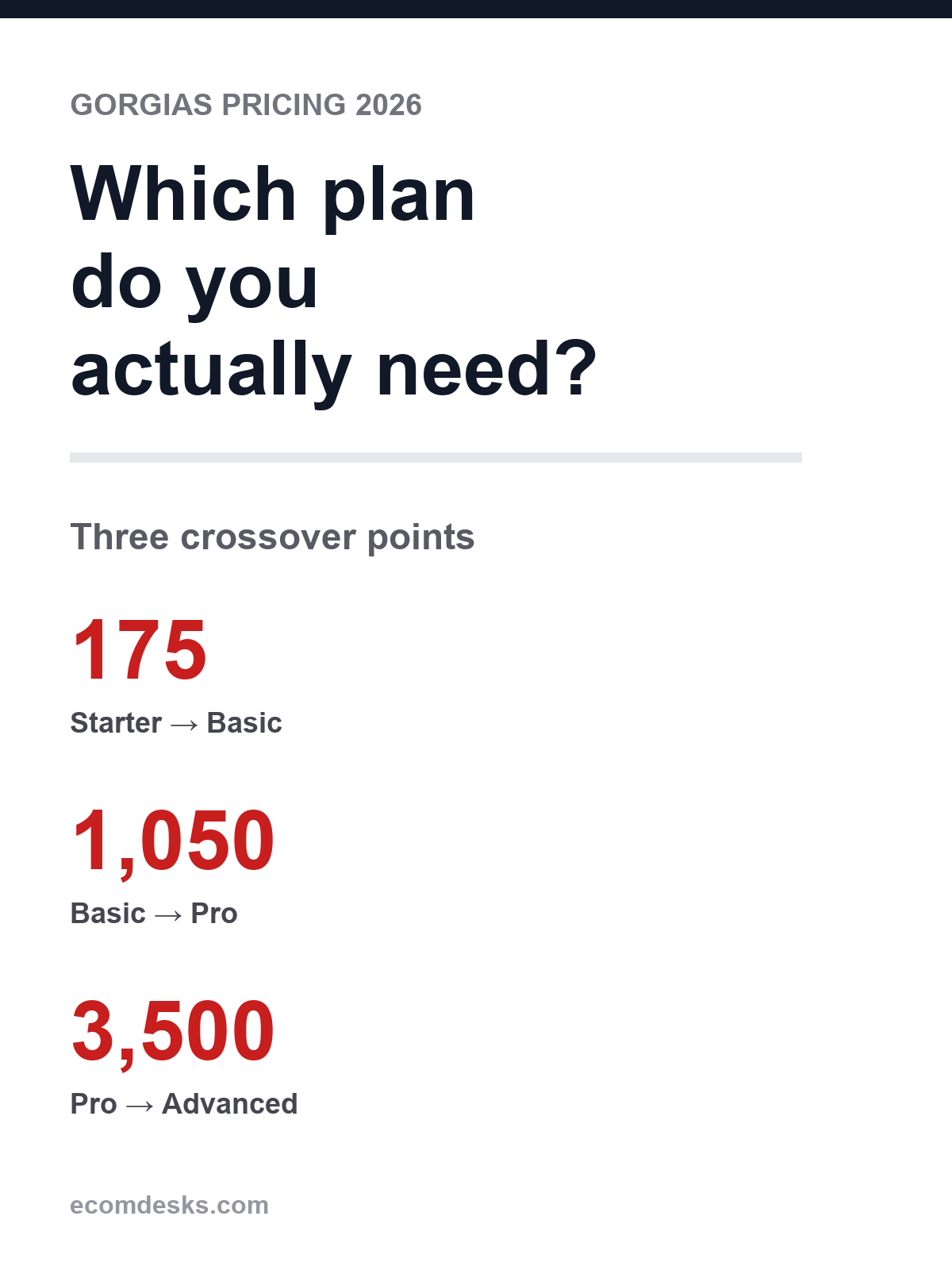
    Three crossover points decide most of this. They assume the plan price without the AI Agent and ignore AI overage, so treat them as the floor.

    Monthly ticketsCheapest planMonthlyWhy
    Under 175Starter$40 to $9050 tickets plus $0.40 overage still beats Basic
    175 to 1,450Basic$90 to $550300 tickets plus $0.40 overage
    1,450 to 4,444Pro$550 to $1,4302,000 tickets at the lower $0.36 rate
    Over 4,444Advanced$1,430 and up5,000 tickets before overage starts

    Add automation and the boundaries move inward, because a cheaper plan also has a smaller AI allowance. At 40% automation, Basic beats Starter at about 165 tickets, Pro beats Basic at roughly 1,090, and Advanced beats Pro near 3,470.

    That last shift is the one people miss. Advanced looks like an enterprise plan until you work out that at 3,500 tickets on Pro you are already paying $2,179 with overage, which is more than the Advanced list price.

    How the AI meter works

    An automated interaction is a conversation the agent closes without a human. If the agent drafts and a person edits and sends, that is a handled ticket, not an automated interaction. The distinction matters because the two meters move at different speeds: tickets follow order volume, automated interactions follow order volume multiplied by how much you let the agent finish on its own.

    The allowance is small. Pro includes 190 automated interactions against 2,000 tickets, under 10%. Basic includes 30. At 40% automation you are over the allowance on every plan except Advanced, which is why the AI overage shows up on almost every real bill.

    Overage is $1.00 per interaction on Starter, $0.90 on Basic and Pro, and $0.85 on Advanced. There is no volume break within a plan, so the 200th extra interaction costs the same as the 900th.

    Three bills at 40% automation

    StoreTicketsAI conversationsPlan that fitsMonthly bill
    New store, one person300120Basic$171
    Growing brand, three people1,200480Pro$811
    Multi-channel brand4,0001,600Advanced$2,340

    Two of the three land on a plan that is cheaper than the tier below, once overage is counted. At 1,200 tickets, Basic would cost $855 against $811 on Pro. At 4,000 tickets, Pro would cost $2,539 against $2,340 on Advanced.

    That is the practical rule for this pricing: compare the bill at your volume, not the plan name at your headcount. If the plan still looks wrong for your volume, seven alternatives are priced on one store.

    Where the bill moves most

    Automation rate. Moving the same 1,500 tickets from 20% to 60% automation adds $540 a month on Pro. Nothing about your order volume changed.

    Seasonality. A store doing 400 tickets for nine months and 3,000 in three peak months pays $8,892 a year on Basic against $10,407 on Pro, because the flat Pro fee is wasted in the quiet months.

    Seats do not move it. Every plan except Starter includes 500 seats, so a team of three and a team of fifteen pay the same unless the ticket count differs. For the per-seat model this replaces, Gorgias vs Zendesk runs the same arithmetic.

    Questions people ask before signing

    Does Gorgias charge per agent? No. It charges per ticket, and every plan above Starter includes 500 seats.

    What happens if I exceed the ticket allowance? You pay per ticket: $0.40 on Starter and Basic, $0.36 on Pro and Advanced. Up to the crossover points above, overage is cheaper than upgrading.

    Is the AI Agent included? Yes, as a line item in the plan price. The allowance is 30 interactions on Starter and Basic, 190 on Pro, 530 on Advanced. Past that it is $0.85 to $1.00 each depending on plan.

    Is annual billing worth it? It is cheaper, and the page only shows monthly rates until you switch the toggle. Measure a full month of tickets and automation first, then price the year.

    What changed, and why older numbers are wrong

    Earlier versions of this page quoted $10, $60, $360 and $900, with AI overage at $1.50 per interaction. Those were the helpdesk prices, and the AI fee sat outside the plan.

    Gorgias now sells the agent as a line of its own. The four helpdesk prices did not move, which is why older reviews still look right at a glance. What is new is the add-on: $30 on Starter and Basic, $190 on Pro, $530 on Advanced.

    Overage also fell, from $1.50 to $0.90 on Basic and Pro, and $0.85 on Advanced. Heavy users pay less per interaction than before. Everyone pays more before they send anything.

    Bottom line

    Budget from the total column, not the plan column. For the reference store at 1,500 tickets and 40% automation that means $919 on Pro, and any number below that is a quote for a different volume. The wider list of seven tools puts those bills side by side.

    If you want the full assessment of whether the product earns that bill, the Gorgias review covers what works, what does not, and what leaving costs.

    Prices read from Gorgias’s public pricing page on November 18, 2026. Bills are calculated from published rates, not from an account we ran.

    Disclosure: some links on this site are affiliate links. If you start a paid plan through one, the vendor pays a commission at no extra cost to you.

    Check Gorgias’s current plans

EcomDesks · Independent reviews of ecommerce support and operations software

Home · About · Alex Mercer · Contact · Privacy